

#75 The Knowledge Bottleneck 🧠
This week, our open source expert is Ricardo Sueiras, our spotlight is on AWS Principal Developer Advocate Aaron Hunter, and we look at the latest AWS service releases, blog posts, news, and more!


Welcome
In the last issue, our serverless expert was AWS & AI Expert Paul Stack, and our spotlight fell on AWS Community Builder Jamie Walker!
This week, our open source expert is Ricardo Sueiras, our spotlight is on AWS Principal Developer Advocate Aaron Hunter, and we look at the latest AWS service releases, blog posts, hints and tips, news, and more!
This week’s newsletter is sponsored by Leighton.
💡 A quick note from the author: I just wanted to let everyone know that going forward, the newsletters will be every two weeks, to allow me to curate an even better experience for you all - Lee.
📰 Articles that caught the eye
Here are some stand-out articles I read during the week in the World of Serverless, AI, engineering and architecture!
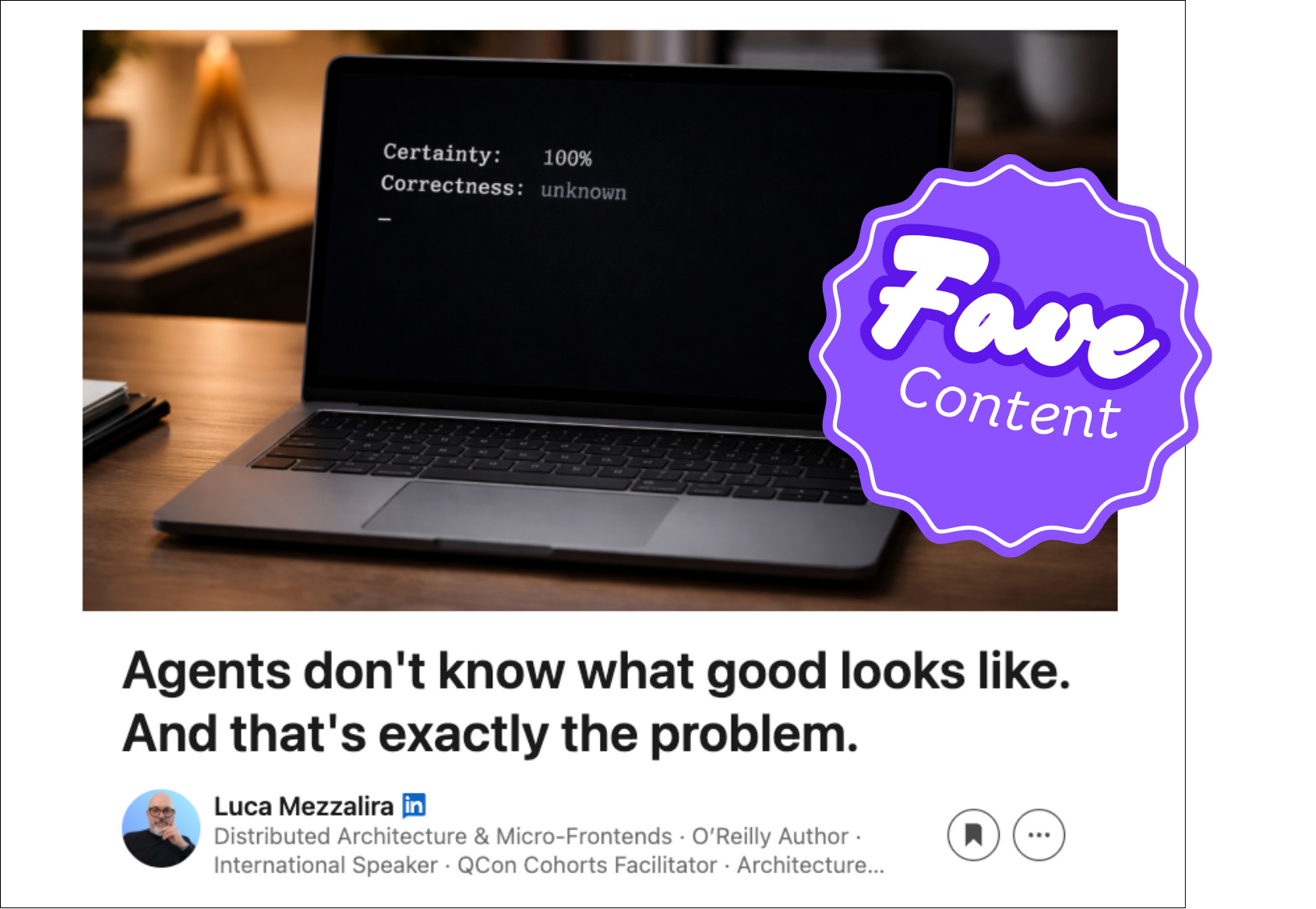
⭐ My favourite article over the past two weeks is by Luca Mezzalira on why agents don’t know what “good” looks like, and why that’s exactly the problem:
Ran Isenberg and Yaron Ben Ezra cover ‘Prevent Sensitive Data Leaks in Amazon CloudWatch Logs’, exploring how CloudWatch Logs Data Protection lets you detect and mask sensitive data before it’s written or forwarded, and how to enforce this centrally across every AWS account.
Allen Helton covered ‘Your AI agents are a security nightmare’ in this great article, discussing how maintenance is often forgotten about when we are building with AI.
Javi López features ‘The Real Bottleneck in Software’, arguing that the real constraint in software engineering is knowledge, not tooling, and why optimising for learning through small batches, TDD, and CI/CD is the path forward.
Jason Conway-Williams has a quick article titled ‘Handling Cross-Region SSM Parameters in AWS CDK’, walking through two practical approaches for sharing Parameter Store values across regions when CloudFront certificates need to live in us-east-1.
Joan Westenberg covers ‘”Collaboration” is Bullshit’, a provocative piece drawing on S.L.A. Marshall’s WWII research to argue that most collaboration tools simulate collective engagement without producing actual output, and that transparency got confused with progress.
Luca Mezzalira has a great article titled ‘Agents Don’t Know What Good Looks Like. And That’s Exactly the Problem’, reacting to the Neal Ford and Sam Newman fireside chat on agentic AI and software architecture, exploring the Dreyfus Model and why agents stuck at the novice level can’t distinguish a valid fix from deleting the test.
Agent Driven Development features ‘We Kissed Specs and PRDs Goodbye. Product Managers Pass POCs Now’, exploring how AI agents are collapsing the gap between product ideation and working software, with PMs building POCs directly instead of writing twelve-page documents.
Gunnar Grosch covers ‘Multi-Agent Systems on AWS Lambda with Durable Functions’, combining Strands Agents SDK with the durable execution SDK to build a purchasing coordinator where each specialist runs as its own Lambda function with checkpointing, parallel dispatch, and human-in-the-loop approval.
Ran Isenberg has a great article titled ‘Claude Code Best Practices: Lessons From Real Projects’, sharing practical lessons from shipping three real projects with Claude Code, covering BMAD vs plan mode, CLAUDE.md structure, and why domain expertise remains the bottleneck.
Jimmy Dahlqvist features ‘Authenticating to MongoDB Atlas with AWS Outbound Identity Federation’, a deep dive into using AWS IAM Outbound Identity Federation for machine-to-machine authentication, eliminating stored secrets by exchanging IAM roles for signed JWT tokens.
Darryl Ruggles covers ‘AWS Lambda Now Knows Where It Lives: Exploring the New AZ Metadata’, exploring the new metadata endpoint that exposes the Availability Zone ID of the execution environment with no VPC required and sub-millisecond response times.
Jeremy Daly has a thought-provoking article titled ‘The Convergence Problem: Rethinking the 2028 Global Intelligence Crisis’, arguing that AI isn’t just accelerating how we build software but compressing it toward sameness, and that the bottleneck has moved from building to deciding.
Kawsar K covers ‘AI Agent Steering File for AWS Serverless Applications’, sharing a practical steering file template for ensuring AI-generated applications follow secure, scalable, well-architected patterns on AWS.
🎓 Ask the Expert
Each week, I ask a different AWS expert the same three questions to get their personal insights, this week, we have Open Source Expert Ricardo Sueiras:

Opinions are the author’s and do not express the views of their employer.
1. What is one common mistake you see teams making when using open source in their solutions, and how can they avoid it?
This is such a great question, and one that, in my experience, changes depending on the background and experience of the developer.
A very frequent mistake is that for a lot of developers they think that open source is about being able to download software and use it for free. And whilst this might look like a characteristic of open source, it is only one part of it. The thing that makes something open source is when the creator of the “work” (in our case, source code) applies a license (specifically, an open source initiative, or OSI, license). These licences provide developers with “freedoms” on what they can do with the source code. You might hear of the four freedoms of open source: the freedom to study (view) source code, the copy the source code, to modify the source code, and to run the source code.
This leads to another common mistake that I see developers make, which is forgetting to add a license to their project, effectively making it proprietary. This effectively means that no one can really use your software in perhaps the way you or they want to. This is important because that license is what provides developers the ability to use software without the negotiation of the rights holder - in essence, it is this that allows everyone to build using and on top of open source. I would argue that this has been one of the key driving forces in software innovation over the past decade.
The final related mistake I see, although this is a lot less frequent these days as the licences being used by projects have changed over the years, is developers not understanding what obligations they are required to follow when they decide to use open source projects. For example, this might be that they need to generate an attribution document that outlines all the open source components they are using within their project and make this available via some mechanisms. You might have seen this if you go to your mobile phone and check the About or Legal sections of an app to see a list of open source projects that are being used.
I also want to add a generative AI footnote here. There are a LOT of mistakes being made about “open source” LLM’s. A lot of this started when META incorrectly stated that Llama was open source - it isn’t. Since then, I keep seeing both the term “open source” incorrectly used to refer to LLM’s. Remember, unless it has an OSI licence, it isn’t open source.
Also, please, please, it is NEVER “open-source” and ALWAYS “open source”!
2. Which tool, package, or service are you most excited about right now, and why?
This is a hard one as I regularly review really nice projects, from both large organisations and individual developers. That said, there are a few projects that for me are stand out and that I use on a regular (daily/weekly)
Strands Agents - this project provides an SDK to developer agentic applications, and what I love about it is both its simplicity and its capabilities. Start simple to get the hang of things, but then keep diving in to add more features as you need them. I love the fact that it works across different model providers and has a growing community that is developing nice tools that you can use. Also, there is some really great content being created to help you really dive into how to create production-quality agentic applications. Top notch, go check it out.
Finch - this is a drop in replacement for Docker Desktop, which I stopped using at the beginning on 2024 as an experiment. I wasn’t sure whether I would be able to stick with it as Docker Desktop is a super nice tool, and I love it. Fast forward to today, and I have been able to stick with Finch and have not had too many issues. The biggest one is that as I use ARM-based MacBooks, I have been caught out building containers that when deployed on AWS default to x86 CPU architectures, and Finch does not support the buildx command switch - but there are other ways to build multi-architecture images, so it’s not a biggie.
Cedar - if you need to do authorisation within your application, then this is still one of the great “unsolved” problems that developers have to deal with. Amazon introduced Amazon Verified Permissions, allowing you to take a policy-based approach, like you might be familiar with when working with IAM policies within your AWS environments, and apply these to your application code. I spent a lot of time building content and demos using Cedar, and it is totally awesome. Last week I was blown away by Sondera, which has created extensions so you can use it within your Claude sessions to help define policies on what Claude can and cannot do.
Zed- I switched to Zed last year, and it makes all other IDEs look pedestrian. I guess I have always been a terminal/CLI person, and whilst IDEs like Kiro and VSCode are awesome in their own way, Zed feels like a breath of fresh air and is my daily editor now.
3. What is your favourite trick or tip that the readers may find interesting?
So I guess the first tip for those of you who are Python developers is to make sure you check out “uv”. It is one of those tools that really does a lot of heavy lifting and makes working with Python SO much easier. I made the transition last year, and it’s now a staple in my agentic AI rules files.
The second tip is about finding cool tools to help you with your project or tasks. Some folk might know that for the past three or four years, I have been running an AWS open source newsletter (you can check out the full list here). I come across a lot of great tools that are created by the community, and I use many of these on a frequent basis. Thanks to the great AWS Community, they provided feedback about creating a repo that listed all the tools and projects that I have featured, and so I put together the newsletter-oss-projects as a result. If I am working on something that might need a new tool, I can normally find a tool to help me out (for example, last week I was building an app that used Amazon S3 to store assets, so I used stree, which works exactly like tree but for your S3 buckets). I have added hundreds of tools to this repo, so if you have not seen that, then check it out - I am sure you are going to find more than a few tools you will be wondering how you ever did without.
The final tip I want to share is about how you use AI coding tools to interact with open source projects. These tools are great, and they are getting better all the time. They have lowered the barrier to being able to contribute code back, and you might be tempted to do this - especially if there is a feature request or bug that you need adding/resolving. If you do, then please be mindful. Maintainers have never been under as much stress and pressure, and many have become quickly burdened with a large influx of new PRs to review. If you do decide to use AI coding agents, then make sure you spend the time to ensure that you read the contribution guidelines (many for example are holding off or pausing AI coding agent contributions), and take the time to check the code generated to make sure that not only does it work, but it follows the norms and expectations of the community (coding conventions, documentation, tests, etc). The bar should be higher from a review perspective on the contributor side, and you need to make sure that you sense-check the code contribution against what the project might be expecting. Avoid huge code dumps - tricky given that our agentic AI coding tools love nothing more than creating code! Finally, be kind to maintainers of the projects you use, as they have probably never been busier.
✅ Bonus tip: join the hashtag#believeinsls discord! There is a community there to answer any questions you may have without getting overzealous on serverless or without judgment! Check it out!…
🧠 Tips & Tricks
This week’s tip is by Stephen Siegert on LinkedIn:
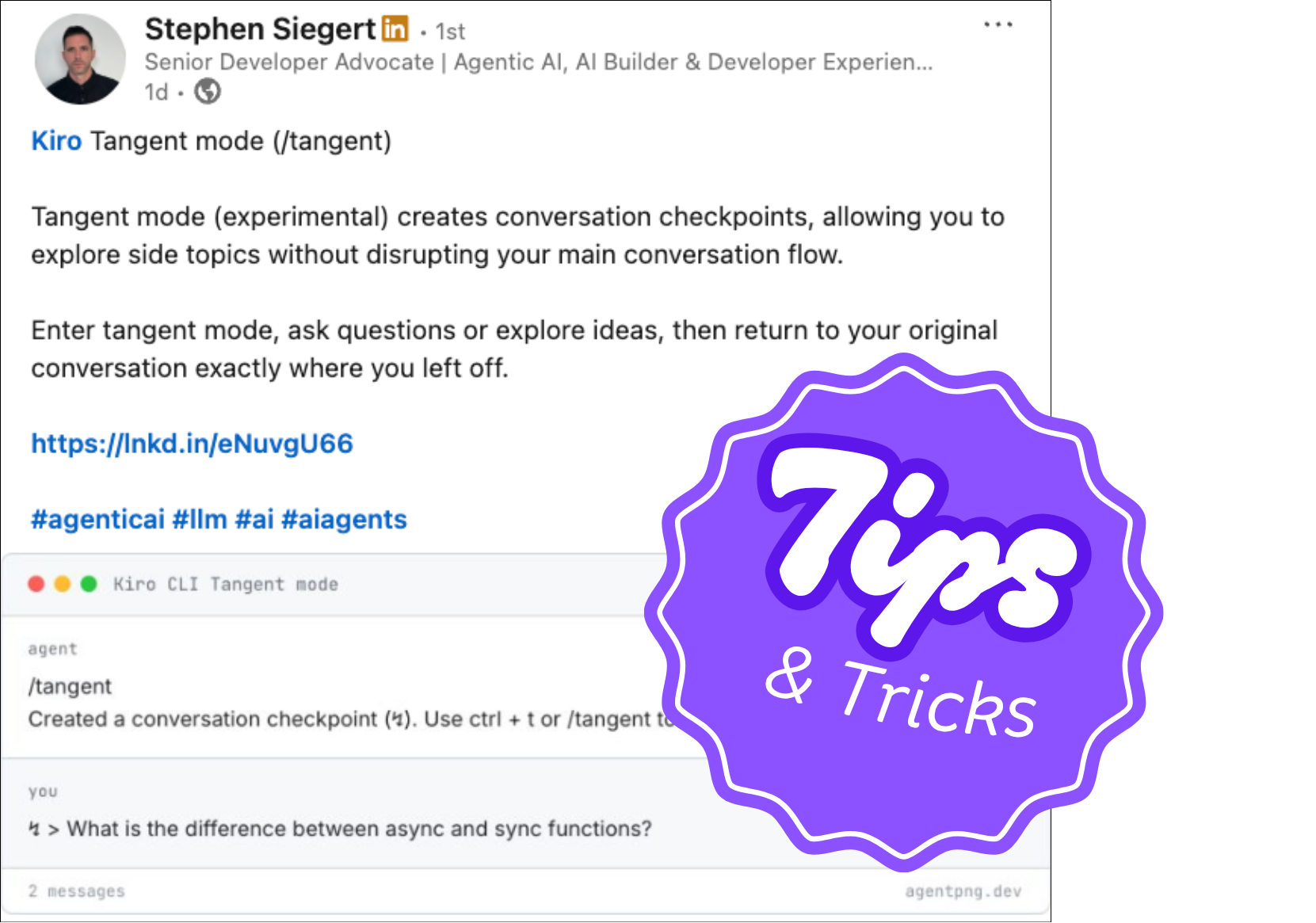
“Kiro Tangent mode (/tangent): an experimental feature that creates conversation checkpoints, allowing you to explore side topics without disrupting your main conversation flow. Enter tangent mode, ask questions or explore ideas, then return to your original conversation exactly where you left off.”
A really handy feature when you want to go down a rabbit hole without losing your place!
🚀 New Releases
Here are the latest and most interesting releases over the past two weeks in the AWS World:
⭐ My favourite releases over the past two weeks are the ones from the Lambda team, as they have been busy, plus the AWS Elemental MediaTailor updates, since I am building in the VoD area at the moment!
Amazon CloudWatch now supports multi-account and region log centralization based on data source.
Access Cluster Insights through the Amazon OpenSearch Service Console and Amazon EventBridge events.
AWS Step Functions adds 28 new service integrations, including Amazon Bedrock AgentCore.
AWS Lambda supports up to 32 GB of memory and 16 vCPUs for Lambda Managed Instances.
Aurora DSQL launches connector that simplifies building Ruby applications.
AWS AppConfig adds enhanced targeting during feature flag rollout.
Accelerate AI-assisted development with Agent Plugin for AWS Serverless.
Amazon Bedrock AgentCore adds support for Chrome policies and custom root CA.
AWS MCP Server (Preview) now with enhanced monitoring and semantic search capability.
Amazon Bedrock AgentCore Runtime adds WebRTC support for real-time bidirectional streaming.
AWS Security Agent now supports downloading penetration testing reports.
🔥 Tip: Check out https://aws-news.com/ for the very latest up-to-date serverless releases as they happen, created by the talented AWS Serverless Hero Luc van Donkersgoed.
✖️ Social of the Week
This week’s social is by Prabhu G. on LinkedIn:
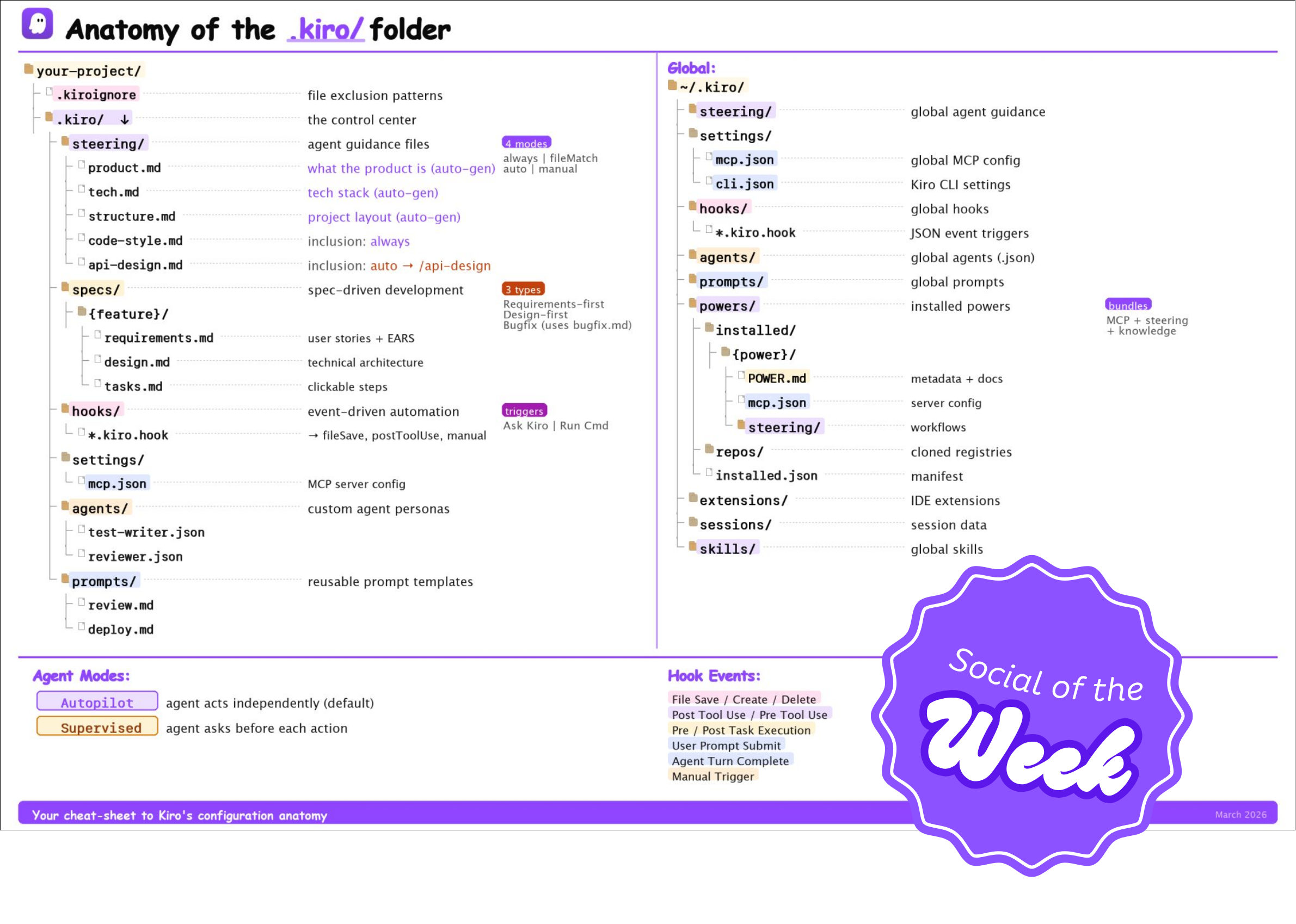
The anatomy of the .Kiro/ folder: a fantastic visual breakdown of how Kiro’s features come into existence, how the files are structured, and what purpose each one serves.
The key insight: global = who you are, project = what you’re building. If you’ve been experimenting with Kiro and things have gone over your head with steering, specs, hooks, powers, and agents, this is the visual guide you need!
What are your thoughts on this post? Leave a comment
Are you looking for a new cloud role and are based in the UK? If so, feel free to reach out to me for a chat about roles at Leighton.
👷🏻 Tools & Frameworks
Check out the latest open-source frameworks, news, and tool updates from the past week.
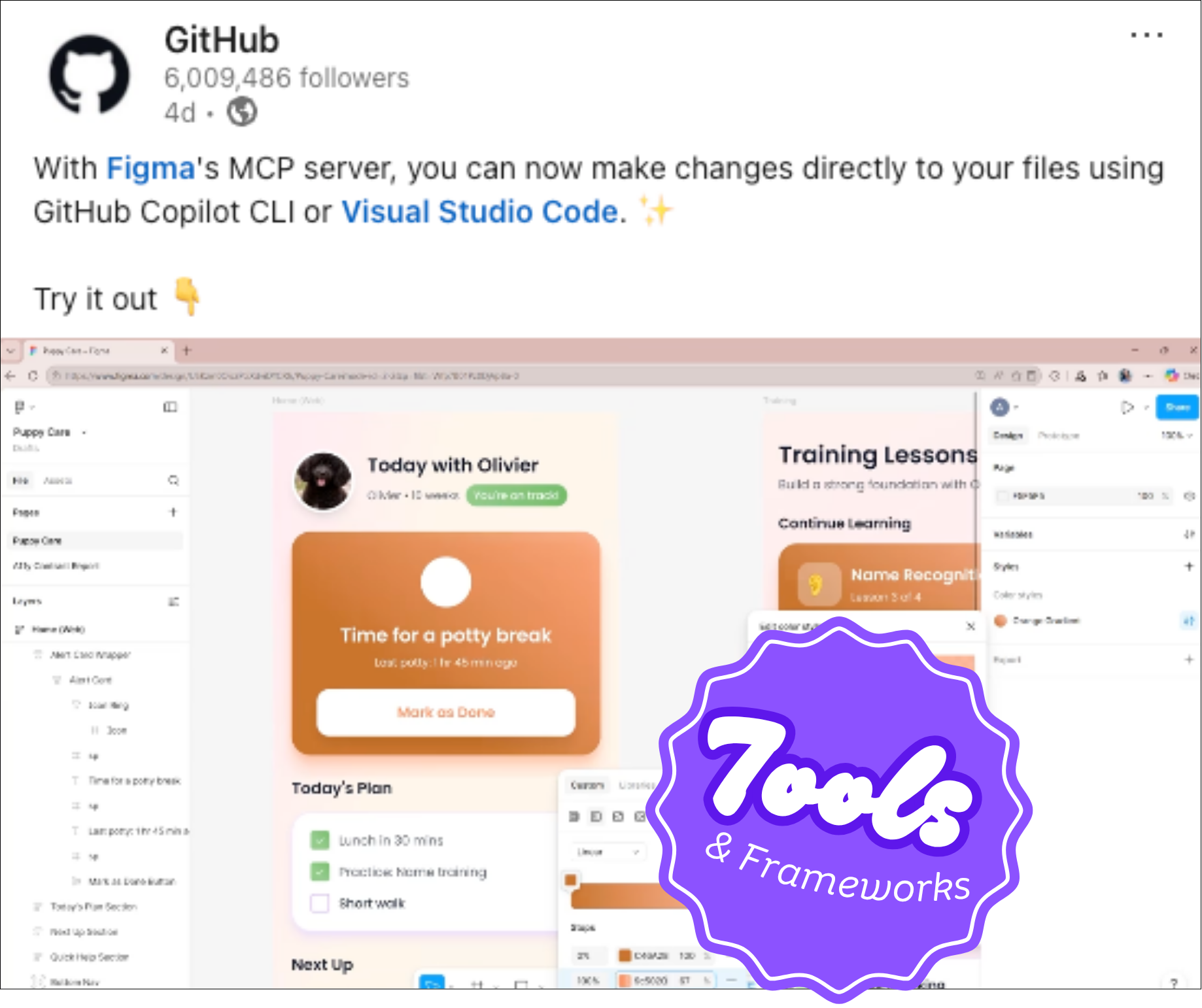
⭐ My call-out tool this week is Figma’s MCP Server for GitHub Copilot. With Figma’s MCP server, you can now make changes directly to your Figma files using GitHub Copilot CLI or Visual Studio Code.
durable-viz - A tool by Gunnar Grosch that turns AWS Lambda durable function handlers into flowcharts using static analysis. Point it at a handler, get a diagram showing every step, parallel branch, invoke, callback, and conditional. Run it as a CLI or as a VS Code extension with a live diagram panel.
TypeORM v1.0 Beta - After more than 10 years, over 190 million downloads, and 4 million every week, TypeORM is finally approaching its v1.0 milestone. The beta is available now via npm install typeorm@beta.
CDK Contribution Skill - An Agent Skill from CDK Labs that combines multiple specialised subagents, AWS tooling, and Agent SOPs to streamline the entire AWS CDK contribution process from issue analysis to PR submission. Implements an orchestrator pattern with human approval gates.
Everything Claude Code - The agent harness performance optimisation system with 120K+ stars. Skills, instincts, memory, security, and research-first development for Claude Code, Codex, Opencode, Cursor and beyond. Now at v1.9.0 with selective install architecture and 12 language ecosystems.
ECR Scan Verifier - An AWS CDK Construct that blocks deployments to ECS, Lambda, and other services when ECR Image Scanning detects vulnerabilities, and optionally verifies container image signatures with Notation or Cosign.
Kiro MCP Manager v1.2.0 - New release of Ryan Cormack’s lightweight macOS menu bar app for managing Kiro CLI MCP server configuration and settings. Now with cleanup period settings, full settings sync with Kiro CLI docs, and knowledge pattern management.
delstack - A CLI tool for deleting AWS CloudFormation stacks, from routine deletions to force deleting stacks with undeletable resources. Unlike CloudFormation’s built-in FORCE_DELETE_STACK, which leaves failed resources behind, delstack actually cleans them up with no orphaned resources.
⚠️ Also, a note for NodeJS and TypeScript developers that axios@1.14.1 and axios@0.30.4 are compromised.
😂 Just for Fun
This week’s “just for fun” post is by Dr Milan Milanović on LinkedIn:

I think we are fine for now lol (check out the link to the video above)
🎙️ YouTube & Podcasts
Here are some of my favourite videos and podcasts this week covering serverless, AI, architecture, and software engineering.
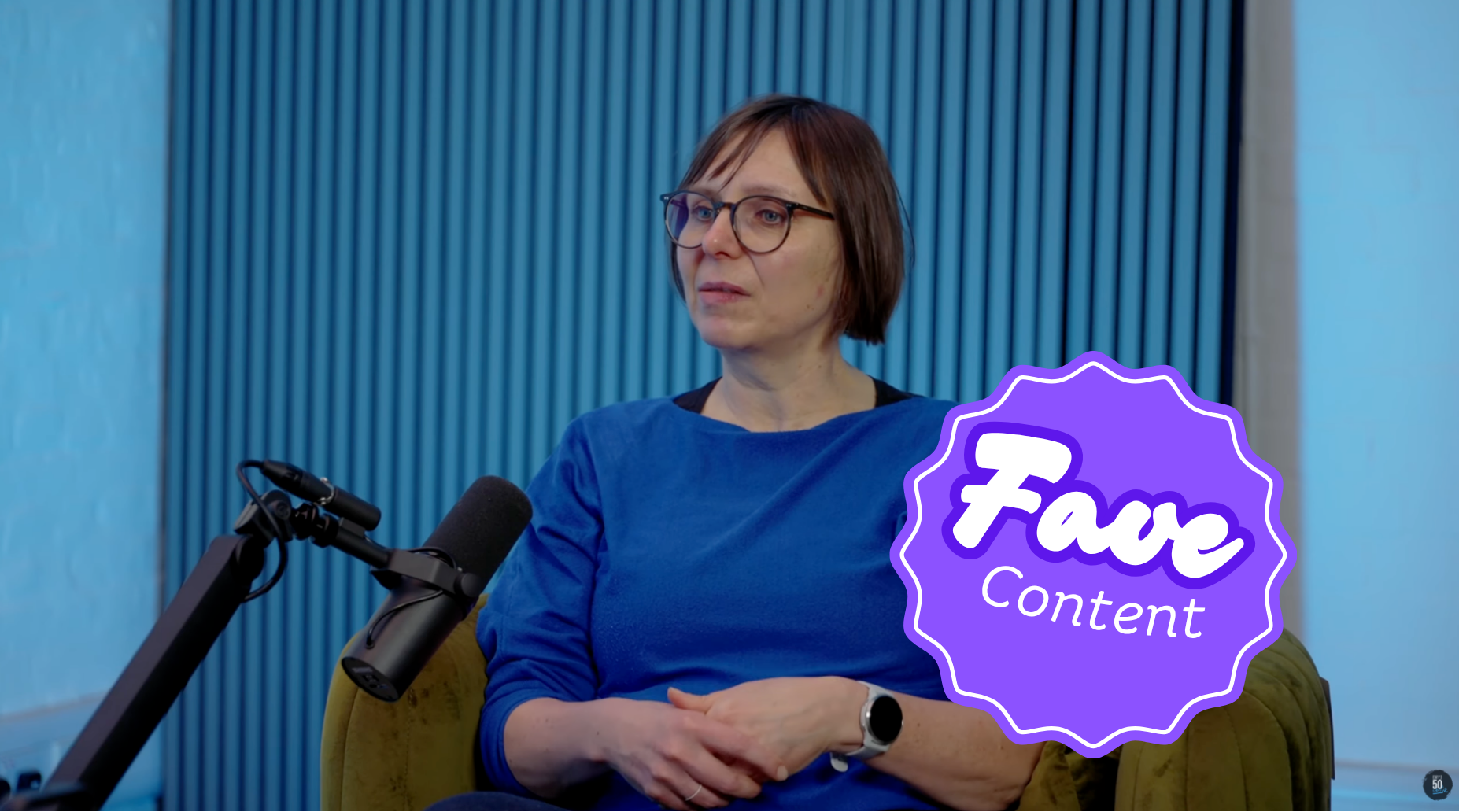
⭐ My favourite video this week is by the My 50 cents channel featuring Susanne Kaiser on ‘Architecture for Flow’!
Debbie O’Brien covers ‘Build Better AI Agent Skills With Skill Creator v2 from Anthropic’.
No Priors features Andrej Karpathy on ‘Code Agents, AutoResearch, and the Loopy Era of AI’.
The PrimeTime covers ‘I Did Not Expect This Ending’.
Derek Comartin at CodeOpinion features ‘Stop Using Event-Driven Architecture for Your CRUD Apps’.
The My 50 cents channel covers ‘Architecture for Flow with Susanne Kaiser’.
Logicata Podcast Season 5, Episode 12 covers ‘Buckets, Chips, and Legal Quips’.
The Modern Software Engineering channel covers ‘Rethinking The Software Lifecycle: How To Look After Software For The Long Term’.
Lenny’s Podcast features Jessica Fain on ‘The Art of Influence: The Single Most Important Skill Left That AI Can’t Replace’.
Domain-Driven Design Europe features Younès Zeriahi on ‘Living Domain Model’ from DDD Europe 2025.
Lex Clips features NVIDIA CEO Jensen Huang on ‘Will AI Replace Programmers?’.
Weekly Case Study 🔍
This week’s case study is by AssemblyAI on AWS:
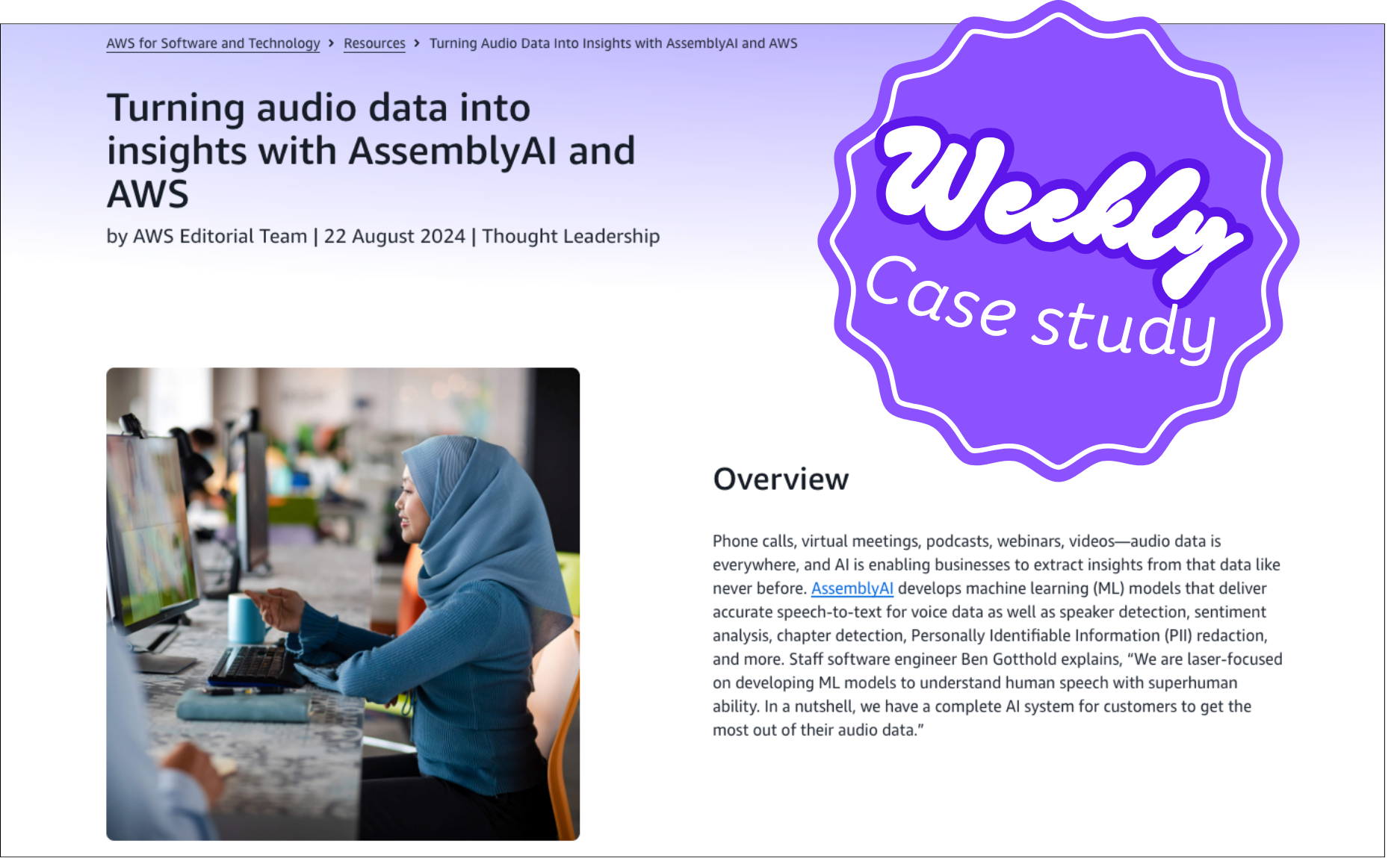
AssemblyAI, a leading speech AI company, partnered with AWS to build a scalable platform for turning audio data into actionable insights.
Customers upload audio data to the AssemblyAI API or submit references via Amazon S3. The data is then transcoded and sent through an inference pipeline powered by an orchestrator that decides which models to call and in what order.
The pipeline leverages Amazon SQS for message queuing, Amazon ECS for running and scaling dozens of ML models, and Amazon S3 for storage. The platform supports features like speaker labelling and sentiment analysis, with models constantly being iterated on and deployed. Amazon ECS automatically scales the ML models up and down based on customer demand, enabling AssemblyAI to efficiently manage its growing model fleet.
🗣️ Inspirational Quotes and Thoughts
This week’s inspirational quote or thought is by Gordon Bell:

“The cheapest, fastest, and most reliable components are those that aren’t there.”
— Gordon Bell
It’s the ultimate architect’s/engineer’s mantra. Every line of code you don’t write is a line you don’t have to test, document, or fix at 3:00 AM. Every component you don’t deploy is one less thing to monitor, patch, and pay for. The best architects don’t add complexity; they remove it, and they make the case for why less is more.
This has never been more relevant than right now in the age of AI. When generating code costs almost nothing, the temptation to add features, abstractions, and “just in case” components has never been higher.
AI makes it trivially easy to create new features that nobody will ever use, new services that nobody asked for, and new layers of indirection that nobody needs. The discipline of restraint, knowing what not to build, is now the most valuable skill an architect can have. Just because you can generate it in thirty seconds doesn’t mean you should ship it.
What are your own thoughts and experiences of this quote? Feel free to leave a comment below.
🗳️ Poll of the Week
In the last poll, we asked the question, “Have you now moved to spec-driven development in your AI-DLC?”
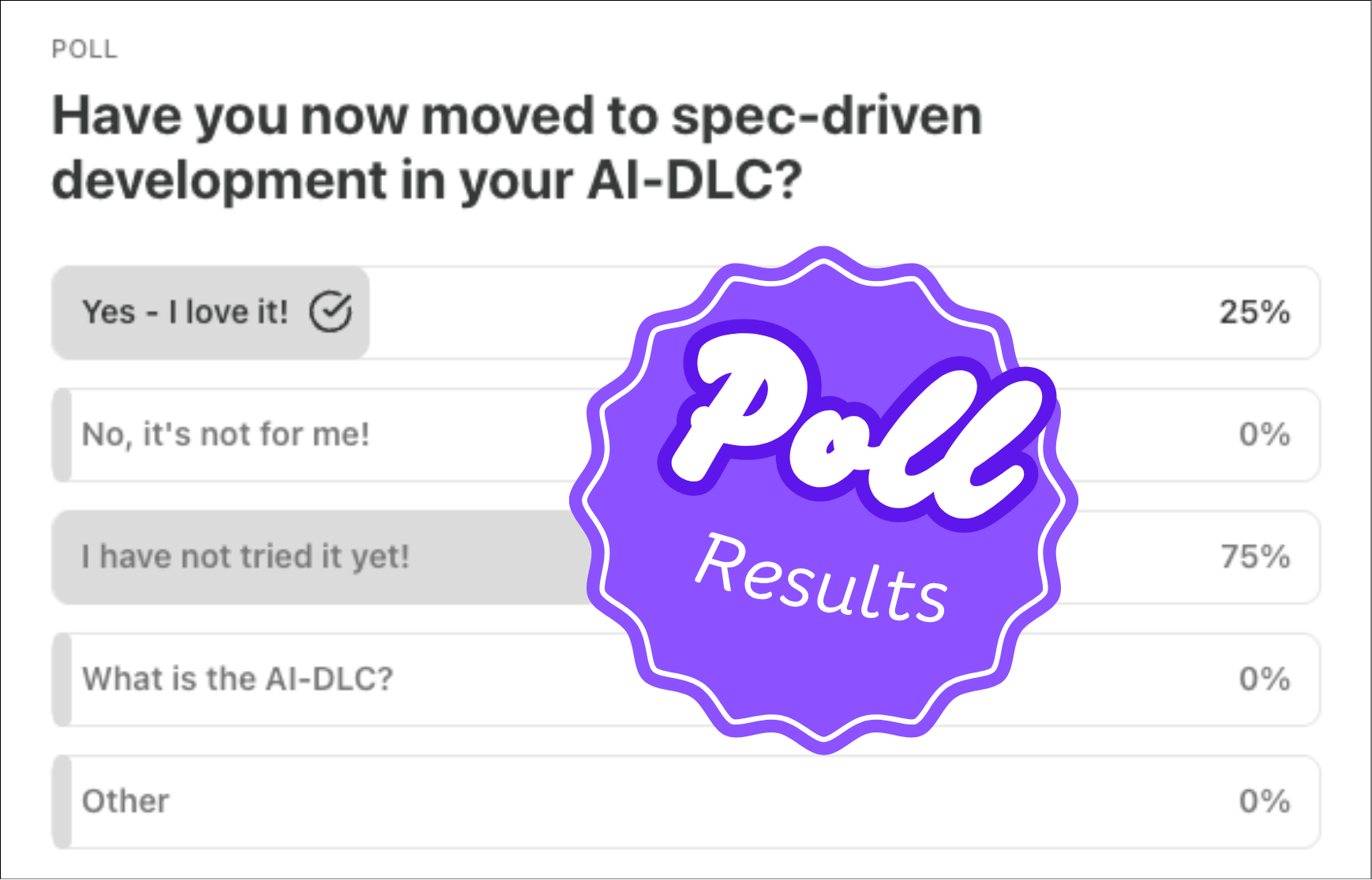
Interestingly, 75% of respondents have never tried the AI-DLC, or perhaps don’t know what it is, with the remaining 25% saying they love it! Im fairly suprised by the numbers, in all honesty.
This week, we ask the question “Is AI development all just hype?”
Please feel free to leave a comment below on your answer.
📅 Serverless Events
The following serverless events are upcoming, so mark your calendars.
ACD Romania - 23rd April 2026.
ACD Athens - 28th April 2026.
ACD Türkiye - 9th May 2026.
AWS Comsum Birmingham - 4th June 2026.
Would you happen to have any upcoming events that you would like to highlight? Message me below!
⭐ Spotlight
This issue’s spotlight falls on AWS Principal Developer Advocate, Aaron Hunter!

Aaron is a Principal Developer Advocate at Amazon Web Services and a passionate advocate for the AWS developer community. He tweets/posts about AWS, learning, certification, and tech, and is known for his super-engaging video content and community presence! Go give him a follow on LinkedIn if you don’t already to stay on top of the latest AWS news and service releases!
He is a regular at AWS events, Conferences, User Groups, AWS live-streams, the AWS Developer Channel, and much more besides! Here is a great recent example on YouTube of his awesome content:
I also have a fond memory of spending time with Andres, Rob, Allen and Aaron out in Dallas, whilst out there for a work trip, where they took great care of us and showed us the local food joints out in McKinney! Aaron is one of the nicest guys in tech, for sure!
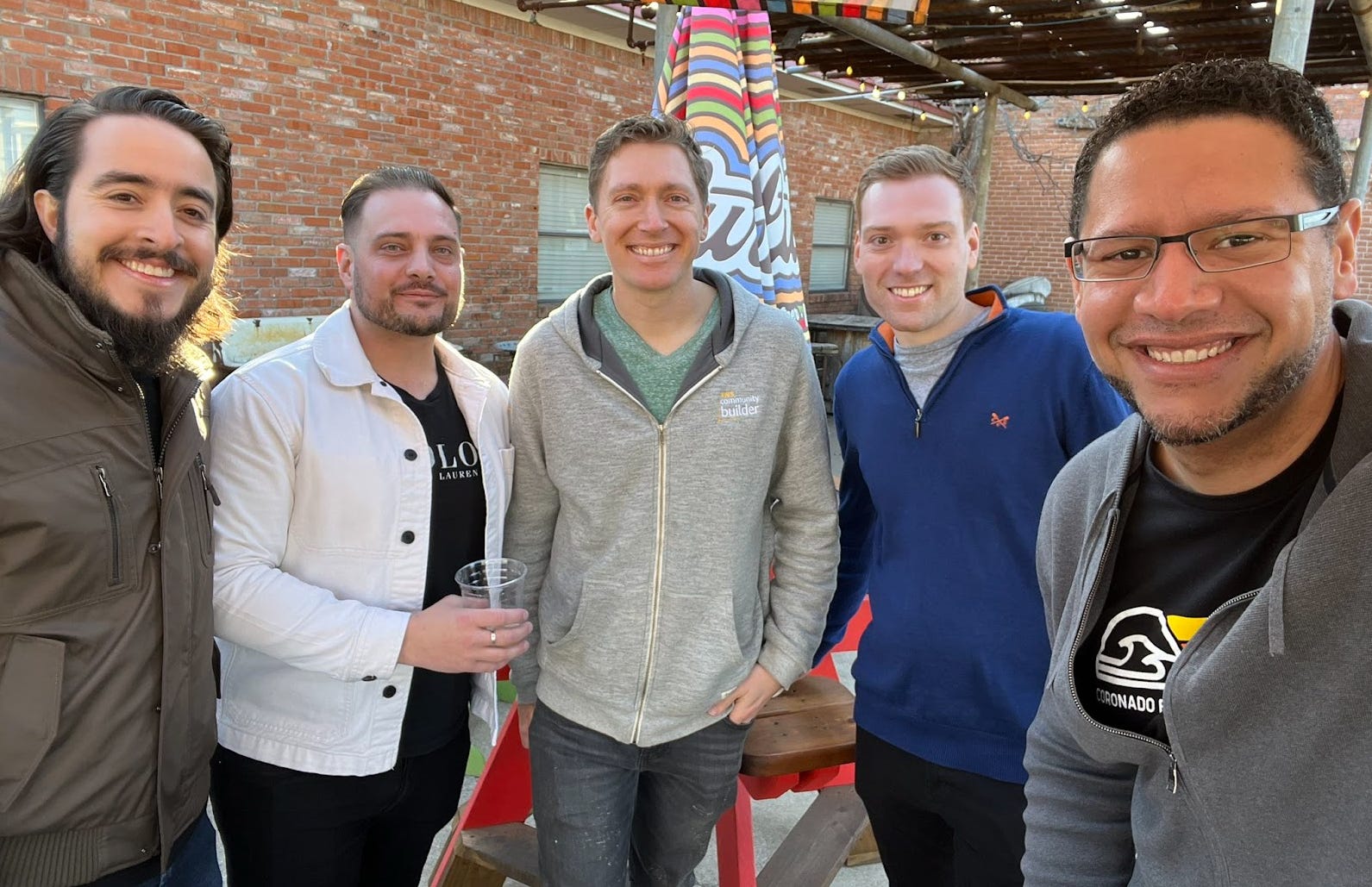
Thank you for everything you do for our amazing AWS community Aaron!
Thank you for reading the latest Serverless Advocate Newsletter!
If you want to find out a little more about me, please have a look at:
https://www.serverlessadvocate.com/
See you next time,
Lee
