

#57 DynamoDB Modelling Made Easy! 🧠
This week, our expert is AWS Community Builder Darshit Pandya, our spotlight falls on AWS Hero Anton Babenko, and we look at the latest service releases, news, & more!


Welcome
In last week’s issue, our serverless expert was AWS Community Builder Guilherme Dalla Rosa, and our spotlight fell on AWS Lambda Senior Software Engineer Maxime David!
This week, our serverless expert is AWS Community Builder Darshit Pandya, our spotlight falls on AWS Hero Anton Babenko, and we look at the latest AWS service releases, blog posts, hints and tips, news and more!
This week’s newsletter is sponsored by Leighton.
A Glimpse into My Week 🎤
This week, I ran two polls on LinkedIn to my 15K+ followers, asking two distinct questions:
Which language do you typically use as your go-to with AWS?
Which IaC framework is your go-to for your AWS solutions?
I do this every year, and here are the results below after 7 days:
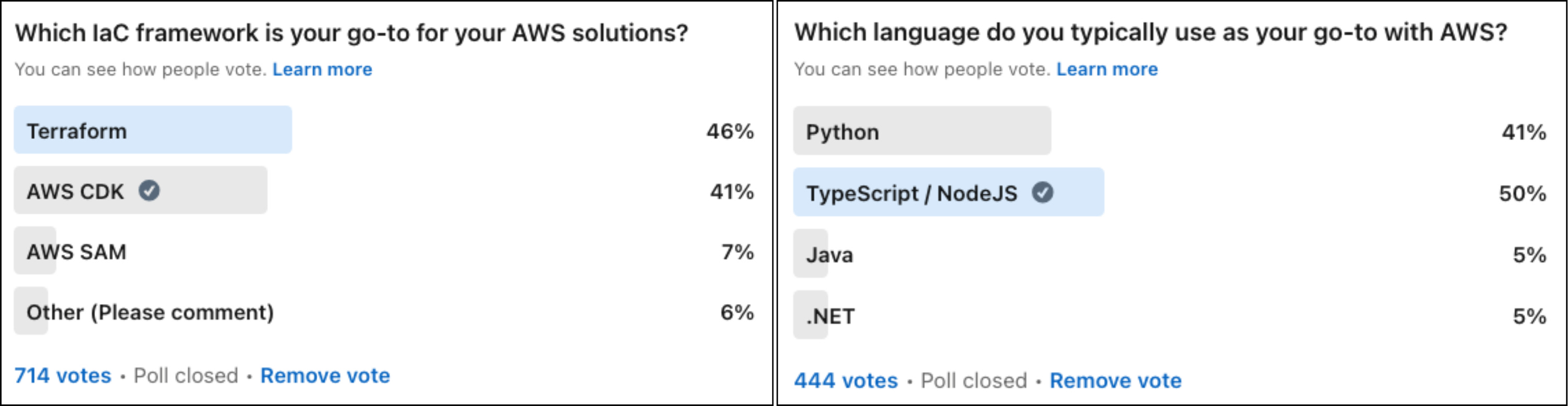
I’m actually not surprised that Terraform pipped the AWS CDK as the most used IaC framework, with it being used across multiple clouds too, and I am not surprised either that TypeScript/NodeJS came out top for most used language. What are your thoughts on the results? Do they align with what you would expect?
📰 Articles that caught the eye
Here are some stand-out articles I read during the week in the World of Serverless, AI, Engineering and Architecture!
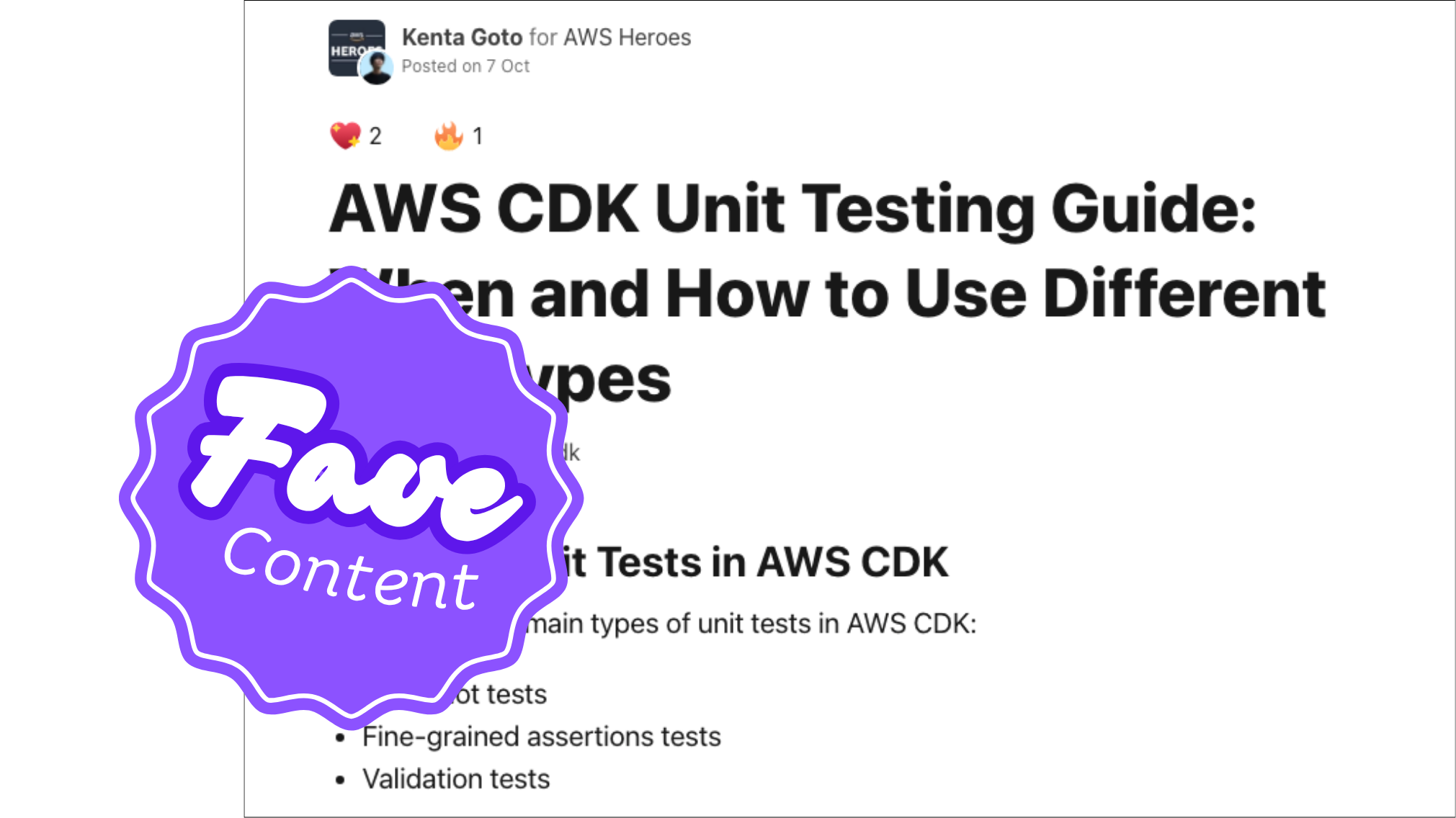
⭐ My favourite this week was by Kenta discussing testing strategies in CDK applications.
Achraf Souk covers ‘Customized interstitial javascript challenge page using AWS WAF Bot Control‘.
Vadym Kazulkin has another part to his series on ‘Amazon Bedrock AgentCore Runtime - Part 7 Using AgentCore long-term Memory with Strands Agents SDK‘.
Kenta Goto covers ‘AWS CDK Unit Testing Guide: When and How to Use Different Test Types’.
Balaji talks about ‘AWS RBAC vs ABAC: Understanding the Key Difference (with Real-Time Examples)’ in this article.
Chris Cook discusses ‘AI SDK Streaming Text from Lambda‘.
Mary Becken has a fun article titled ‘Facing Your Fears in AWS AgentCore Observability - Tracking Malicious Behavior (and Poor Performance)‘.
Greg Farrow asks the question ‘Why Leighton Chose PNPM as Its Default Package Manager — And Why You Might Too‘.
Mahdi Azarboon wrote an article on his thoughts on the good and the bad with ‘Serverless Development with Gen‑AI: Lessons from Amazon Q Developer CLI‘.
🎓 Ask the Expert
Each week, I ask a different serverless expert the same three questions to get their personal insights - this week, we have AWS Community Builder Darshit Pandya:

Opinions are the author’s and do not express the views of their employer.
1. What is one common mistake you see teams making when implementing serverless solutions, and how can they avoid it?
The biggest common mistake I see is platform teams building their Internal Developer Platform (IDP) as an infrastructure vending machine and not considering governance of service interactions. They focus all their energy on the ‘Day 1’ problem: stamping out perfect, abstracted CI and CD pipelines, Serverless services as per requirement (like -Lambda functions, SNS,SQS, Step Functions ,DynamoDB tables etc). And the platform team declares victory when the engineers can self-serve a new capability and spin up a new solution in a minute, but they completely miss the ‘Day 100‘ problem: how do these dozens of services talk to each other reliably and evolve safely?
They forget that in a distributed, event-driven architecture, the real complexity isn’t in the individual functions; it’s in the contracts and the event schemas that bind them together. A brittle event contract is a hidden, time-bomb dependency that the platform has made itself blind to. This leads to what I call ‘schema drift chaos.‘ One team adds a field to a UserCreated event, unknowingly breaking a downstream payment service because the platform (a common mistake) was built to verify the ‘nouns’ of the system, the infrastructure components but was completely blind to the ‘verbs’ the data contracts that dictate communication between them.
The solution is to shift the platform’s focus from merely provisioning resources to actively governing the contracts between them and elevate DevEX. Your IDP must become contract-aware.
Implement “Event Contract Gates” in your CI/CD pipelines. Before a service can be deployed, the platform’s governing pipeline must validate its published event schemas against a central registry. Is it a breaking change? The pipeline can then automatically identify and notify downstream consumers, or even halt the deployment pending their approval.
Automate Type Generation as a Platform Service. When a new event schema is registered, the platform orchestrator (serverless primitives like AWS EventBridge, Step Functions, AWS Proton, or Lambda to react to events within the development lifecycle) should automatically generate typed libraries (like TypeScript interfaces or Python Pydantic models) and publish them to an internal artifact repository. This makes building against the correct contract the path of least resistance for consumer teams.
Visualize the Event Mesh. Any platform must use the schema registry to automatically generate and display a dependency graph. This gives engineers invaluable observability insights into how data flows across the entire system, turning a terrifying “deploy and pray“ moment into a confident, informed decision.
2. Which serverless tool or service are you most excited about right now, and why?
I’m most excited about Amazon CloudWatch Application Signals, because it’s the first tool that directly tackles the ‘context collapse‘ problem that plagues engineers in distributed serverless systems. For years, our observability tools have given engineers three separate, disjointed views: logs (what my code said), metrics (how my resource behaved), and traces (which services were called). During an outage (imagine at midnight, at 3 AM in the middle of a nice sleep), the engineers become a digital archaeologists, trying to piece together a story from these fragments.
Application Signals changes this by automatically reconstructing the business transaction’s narrative.
What excites me isn’t just the service map; it’s the ability for a platform team to provide this narrative automatically (aka Out of the Box). We can encode our business knowledge into the platform itself. The golden path constructs don’t just create a Lambda; they register its business purpose. For example, this function is part of the UserCheckout flow, and its SLO is 200ms with 99.95% availability.
This elevates the platform from an infrastructure provider to a business observability enabler. The developer experience is transformed:
The alert an engineer received isn’t “P99 Latency for checkout-lambda-xyz is high.” It’s “The UserCheckout SLO is at risk because of increased latency in the downstream payment-provider service.”
When engineers click a single link, they see the entire correlated flow, the trace showing the slow external call, the logs from that specific invocation, and the metrics showing the blast radius of customer impact, all in one place.
This closes the feedback loop between code and business outcome. Engineers can finally see not just that their function is failing, but why it matters. When IDP provides this level of context by default, we empower teams to build more resilient and performant systems.
3. What is your favourite trick or tip when working with serverless that the readers may find interesting?
My favorite technique is to treat the Internal Developer Platform itself as a first-class serverless application, using what I call “Callable Platform Primitives“ built on Lambda Function URLs. The mistake is to think an IDP needs a traditional ‘backend’ or a complex developer portal to start with. Instead, every action an engineer or process needs to perform becomes a standalone, secure, and auditable Lambda function with a URL.
A custom CLI exposes the platform’s capabilities through simple, intuitive commands. For example, a command like platform-cli create service --name my-app translates behind the scenes into a direct, authenticated call to the service-provisioner function’s URL. Likewise, a command to look up deployment history, such as platform-cli list deployments, acts as a user-friendly wrapper that calls the deployment-api function’s URL to retrieve the data.
The key is a shared middleware layer that wraps every one of these functions. This layer is not just for authentication; it’s a platform governance and audit engine. Before any business logic runs, this layer handles three critical tasks:
Authentication: It validates a JWT from the organisation’s identity provider, ensuring every call is from a known entity.
Authorization: It checks fine-grained permissions to ensure the caller has the right to perform that specific action (e.g., only a senior engineer on Team X can trigger a production deployment for their service).
Auditing: Most importantly, it creates a detailed, non-repudiable audit log for every single request who made the call, what action they took, from where, and the result. This gives you an immutable, centralized record of every change made across your entire ecosystem.
This isn’t just a trick; it’s a philosophy. The IDP becomes a constellation of serverless capability as scalable, resilient, and cost-effective as the serverless applications it helps teams build. You’re dogfooding your own architectural principles, and the result is a lightweight, secure, and profoundly powerful platform built with the very primitives it promotes.
✅ Bonus tip: join the hashtag#believeinsls discord! There is a community there to answer any questions you may have without getting overzealous on serverless or without judgment! Check it out!…
🧠 Tips & Tricks
This week’s tip or trick comes from my company, Leighton, and to check out an early release of our Lambda Toolkit, which one of the teams has put together as a start of a bigger open-source project:
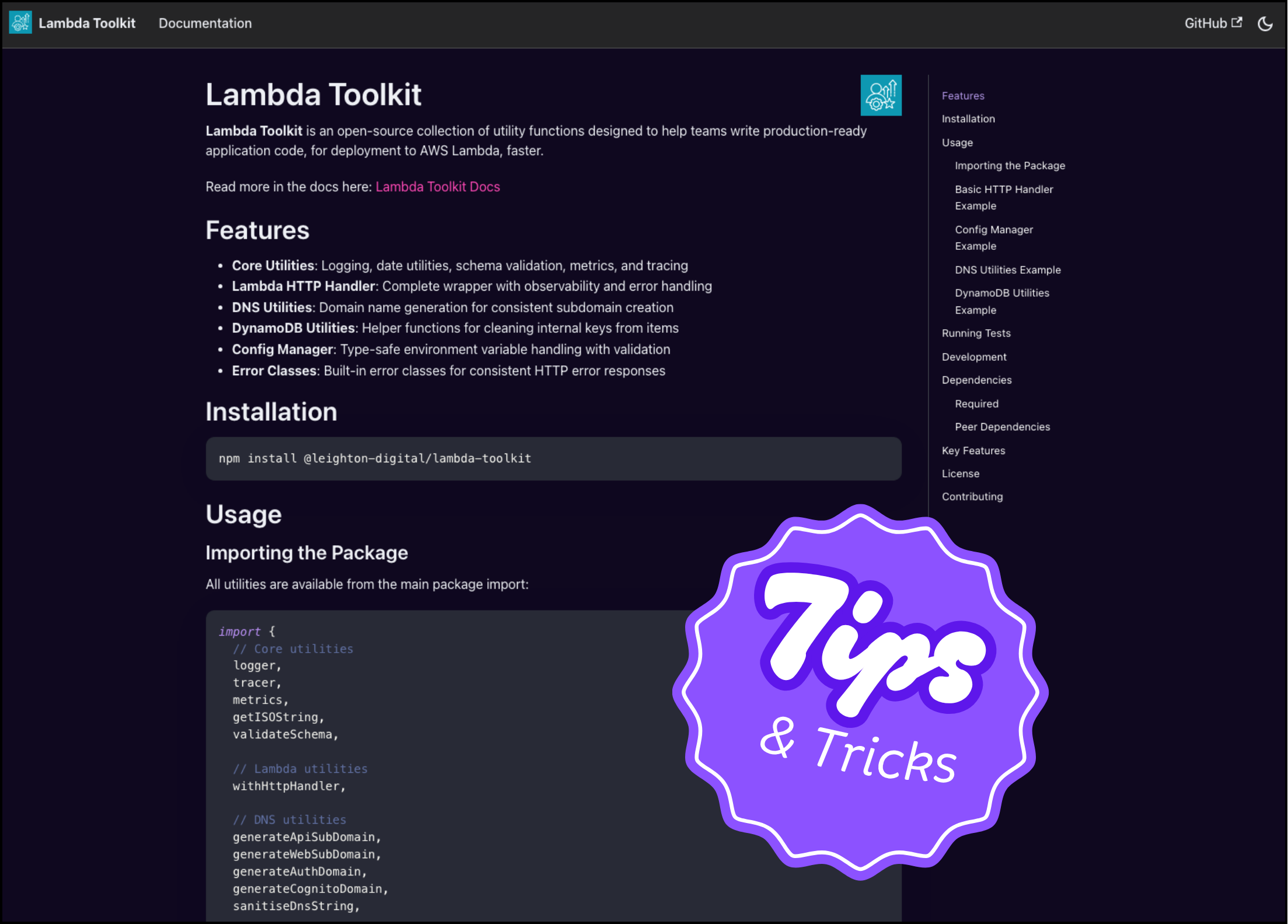
This package works in sync with our curated Cloud Blocks CDK constructs in unison, and covers key areas like:
Core Utilities: Logging, date utilities, schema validation, metrics, and tracing
Lambda HTTP Handler: Complete wrapper with observability and error handling
DNS Utilities: Domain name generation for consistent subdomain creation
Config Manager: Type-safe environment variable handling with validation
Error Classes: Built-in error classes for consistent HTTP error responses
Go check it out!
🚀 New Releases
Here are the latest and most interesting releases this week in the AWS World:
⭐ This week, I was not massively enthused with the service updates, but here they are:
Introducing Amazon Quick Suite: your agentic AI-powered workspace.
Amazon EKS and Amazon EKS Distro now supports Kubernetes version 1.34.
AWS IAM Identity Center now supports customer-managed KMS keys for encryption at rest.
Amazon DynamoDB now supports Internet Protocol version 6 (IPv6).
Amazon Q Developer now help customers understand service prices and estimate workload costs.
Amazon VPC Lattice now supports configurable IP addresses for Resource Gateways.
Automatic quota management is now generally available for AWS Service Quotas.
Amazon Kinesis Video Streams now supports IPv6 for Streams capability.
🔥 Tip: Check out https://aws-news.com/ for the very latest up-to-date serverless releases as they happen, created by the talented AWS Serverless Hero Luc van Donkersgoed.
✖️ Social of the Week
This week’s social is by Yew Jin Lim, and the attached article to the LinkedIn post hit hard!

This is a great read (especially for me, as I am fast approaching 45), and one that actually has me questioning a lot about how I live my life day-to-day and what my actual life goals are. I will write a post or article on my thoughts in reflection to this.
Feel free to leave a comment below once you have read it.
👷🏻 Tools & Frameworks
Check out the latest open-source frameworks, news, and tool updates from the past week.
data-api-client - The Data API Client is a lightweight wrapper that simplifies working with the Amazon Aurora Serverless Data API by abstracting away the notion of field values.
gemini-cloud-assist-mcp - This server connects Model Context Protocol (MCP) clients such as the Gemini CLI to the Gemini Cloud Assist APIs. It allows you to use natural language to understand, manage, and troubleshoot your Google Cloud environment directly from the local command line.
resy - Remote Sync change detection lib. Currently supporting AWS S3 but possibly open to more sources.
vibe-kanban - Vibe Kanban streamlines modern AI-driven development by helping engineers orchestrate, review, and manage multiple coding agents and their tasks from one centralised workspace.
kiro-mcp-manager - A Kiro extension for managing Model Context Protocol (MCP) servers with grouped templates and individual server control.
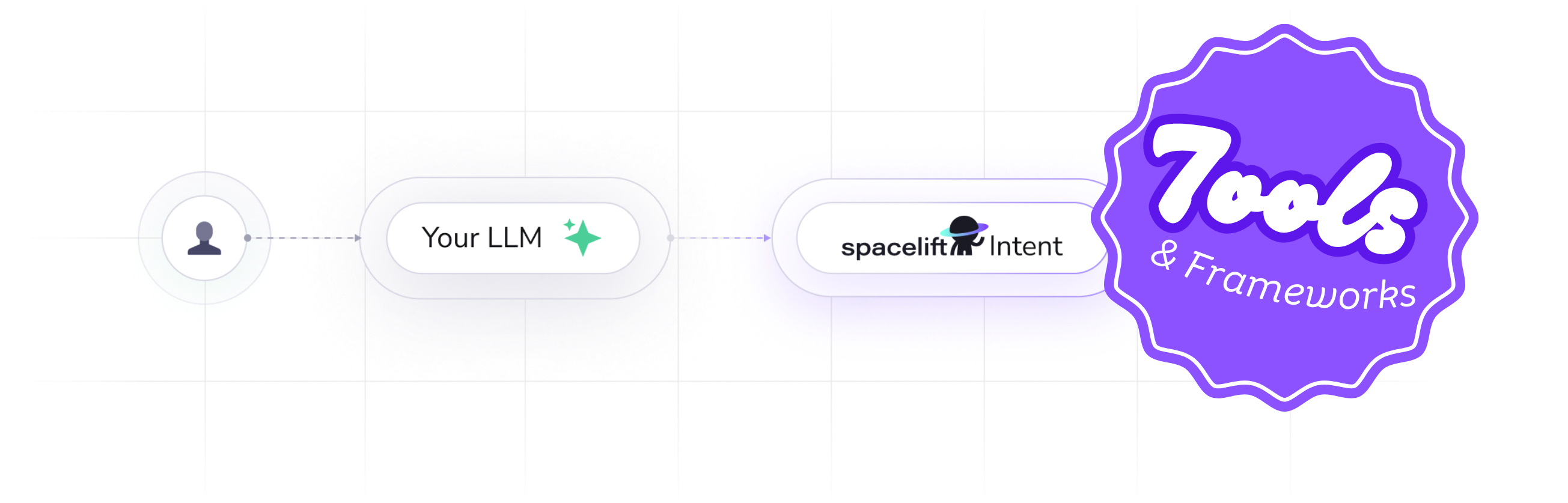
spacelift-intent - Spacelift Intent is an MCP Server that lets you define cloud resources in natural language and have them provisioned by directly calling provider APIs - no OpenTofu or Terraform code required.
😂 Just for Fun
This week’s post is by Fabian Peter on LinkedIn:

This is so so true! (or maybe I am just old!)
🎙️ YouTube & Podcasts
Here are some of my favourite videos and podcasts this week covering serverless, AI, architecture, and software engineering.
⭐ My favourite video this week was by Lee and Kevin on the Believe In Serverless podcast! This would have took so much cognitive load off me in the past!
Derek Comartin discusses ‘The Real Truth About Event-Driven Architecture‘.
Dave Farley asks the question, ’Has This Report EXPOSED THE TRUTH About AI Assisted Software Development?’.
The Believe In Serverless podcast has Lee Hannigan and Kevin Willis discussing ‘Using AI to Design World-Class NoSQL Data Models‘.
This is crazy, and highlighted by The Prime ‘2 years later its still happening‘.
Darko Mesaros covers ‘How Game Developers Can Use Amazon Q with Blender, Unity & Perforce‘.
Find out what has changed in ‘Bun v1.3‘.
Srushith Repakula discusses ‘Serverless: Fast to Market, Faster to the Future‘.
Serverless Office Hours covers ‘Dynamically routing requests with Amazon API Gateway Routing Rules‘ with guests including friend of the newsletter Anton Aleksandrov.
Weekly Case Study 🔍
This week’s case study comes from Epic Games!
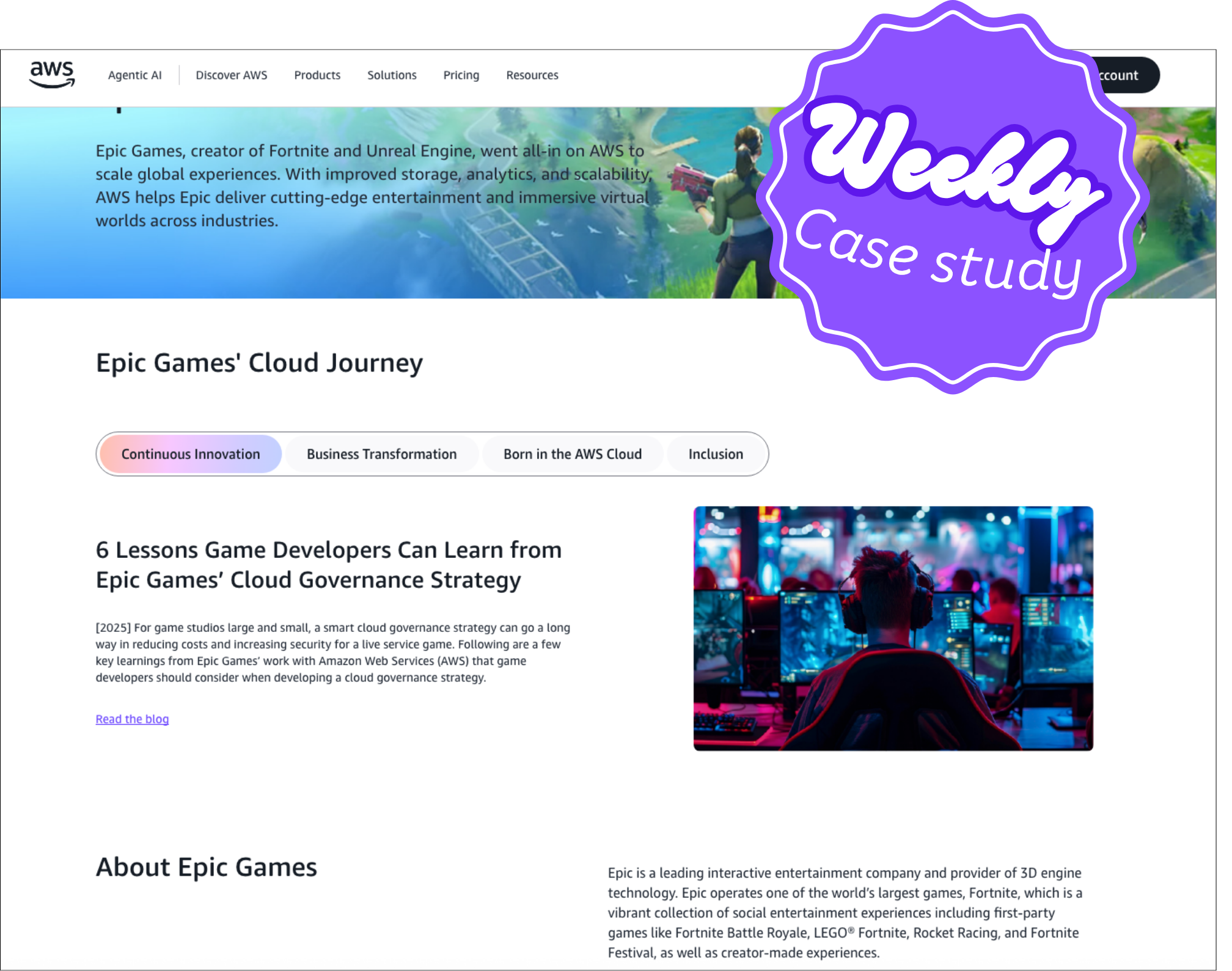
Epic Games, creator of Fortnite and Unreal Engine, went all-in on AWS to scale global experiences. With improved storage, analytics, and scalability, AWS helps Epic deliver cutting-edge entertainment and immersive virtual worlds across industries. Read the case study, which covers key aspects like continuous innovation, business transformation, and inclusion.
🗣️ Inspirational Quotes and Thoughts
This week’s inspirational quote is by the creator of the C4 Model, Simon Brown:

“A software architect who codes is a more effective and happier architect.“
Simon Brown
This quote, in my opinion, is 100% spot on when it comes to AWS (and in particular serverless). I recently joined a call with a software architect who couldn’t answer some of my basic questions, yet had architected the system with beautiful boxes, icons, and lines. He clearly didn’t have the lower-level knowledge of the AWS services that an engineer would have to realise that his design was flawed and wouldn’t work on many levels.
What are your own thoughts and experiences of this quote? Feel free to leave a comment below.
🗳️ Poll of the Week
In last week’s poll, we asked the question “What is your go-to for configuration in AWS CDK applications?”.
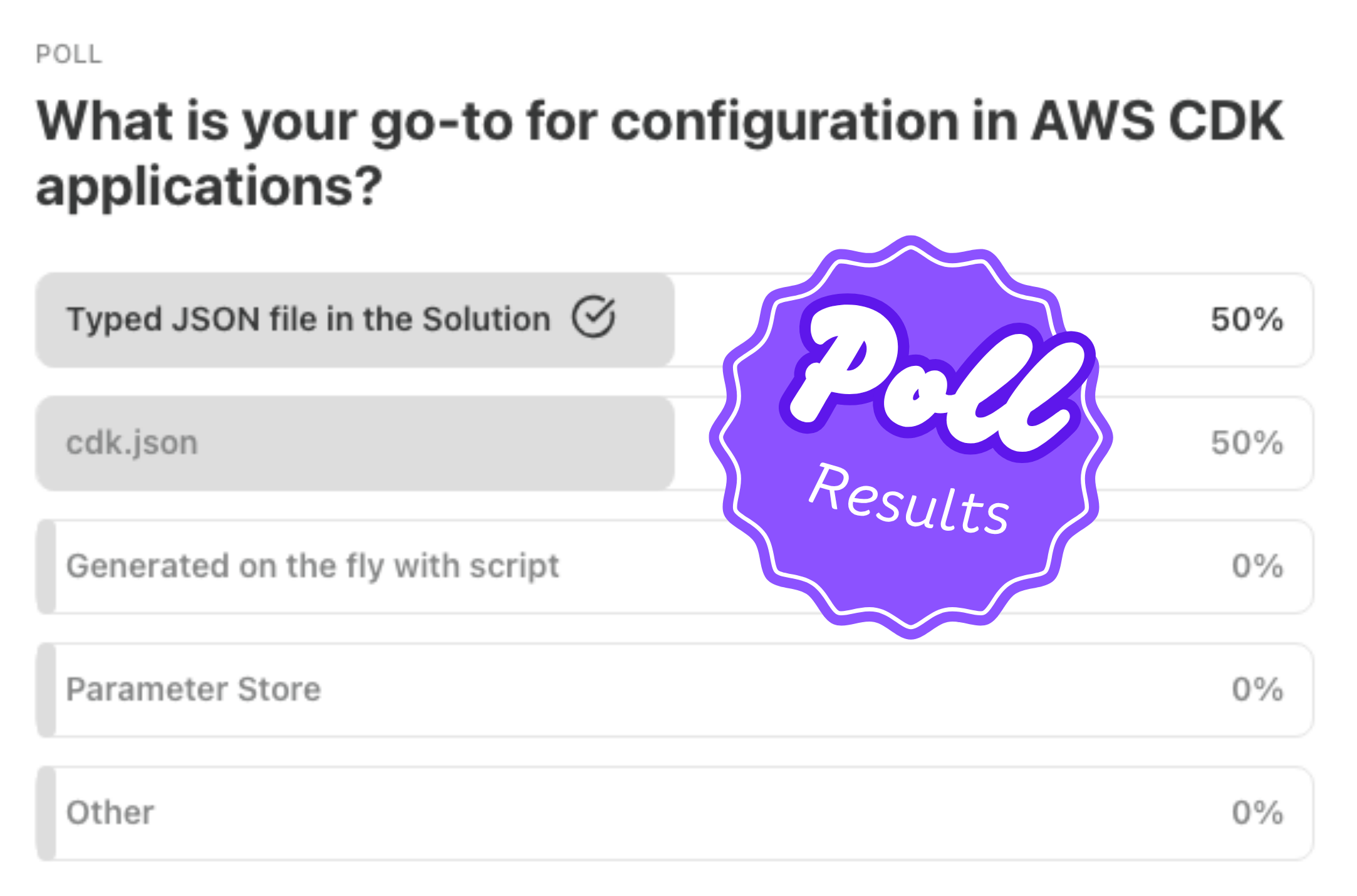
Interestingly, it was 50/50 between using a typed JSON file vs using the cdk.json file. As it happens I cover in my latest talk why I prefer a typed object over using the cdk.json, so next week I will share the talk recording so check it out!
This week, we ask the question: “Which AI tool are you currently using in your software development?“
Please feel free to leave a comment below on your answer.
📅 Serverless Events
The following serverless events are upcoming, so mark your calendars.
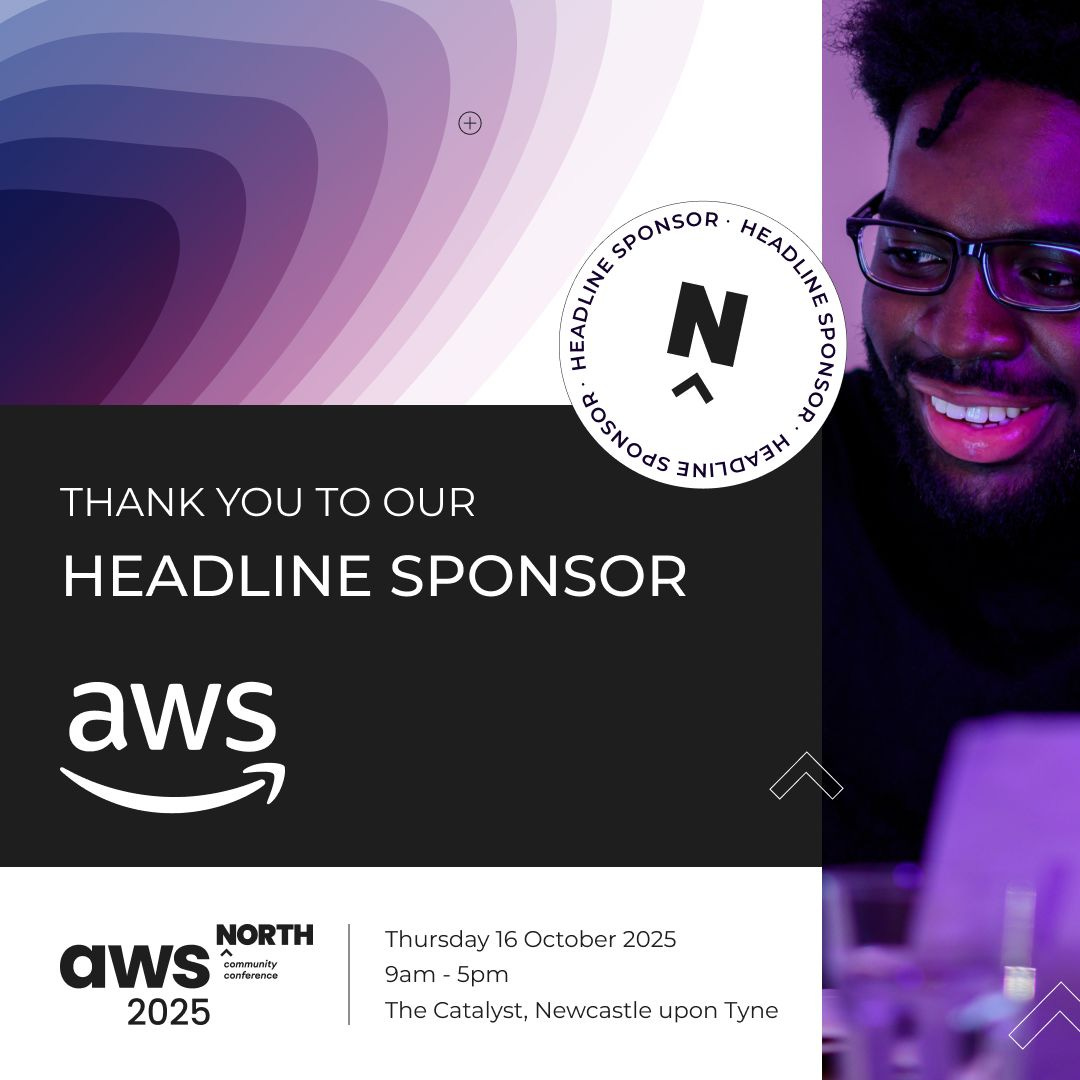
🎟️ To note, tickets are still available for the AWS North Community Conference, which I am helping organise, so go check it out!
Other fantastic events happening soon:
AWS North Community Conference - 16th Oct 2025
ServerlessDays Milano - 21st Oct 2025
ServerlessDays Cardiff - 23rd Oct 2025
Serverless Architecture Conference - 20th-22nd Oct 2025
ServerlessDays Sao Paulo - 5th Nov 2025
Do you have any upcoming events that you want to highlight? Message me below!
⭐ Spotlight
This week’s spotlight falls on AWS Hero Anton Babenko!

Anton is an AWS Hero, an international speaker (very active!), founder of compliance.tf, has his own great newsletter, ebook creator, open-source contributor, YouTube content creator, and much, much more besides! (where do you find the time Anton!)
When I think of Terraform, I naturally think of Anton, as he has produced so much amazing content and shared so much of his experience in this space with the global community for such a long time!
A great example of one of his talks is below:
Thank you for everything you do for our amazing community Anton!
Thank you for reading the latest Serverless Advocate Newsletter!
If you want to find out a little more about me, please have a look at:
https://www.serverlessadvocate.com/
See you next time,
Lee

I've been really happy with VS Code + Copilot using Claude Sonnet 4.5, but this weekend I've been experimenting with Claude directly in the terminal.