



Welcome
In the last issue, our serverless expert was AWS Hero Bhuvaneswari Subramani, and our spotlight fell on AWS Principal Solutions Architect Prasad Rao!
This issue, our expert is AWS Community Builder Lee Harding, our spotlight is on AWS Senior Solutions Architect Julie Elkins, and we look at the latest AWS service releases, blog posts, hints and tips, news, and more!
This week’s newsletter is sponsored by Study From Experts, The Exclusive Home of AWS Deep-Dive Mastery. Gain access to a private library of advanced courses from the world’s most renowned AWS experts, with content so specialised, you won’t find it on any other platform.

Stripe London Developer Meetup
This week Mark Sailes covered “8 Currencies,15 Countries,2 People” - What Merchant of Record actually handles, and why we stopped trying to do it ourselves, at the Stripe Developer meetup in London.

At Study From Experts, we sell advanced AWS courses to engineers in 15 countries, and there are two of us. Here is what we learned about who is really selling when money crosses a border.
Go check out the link for a sneaky discount code!
📰 Articles that caught the eye
Here are some stand-out articles I read during the past two weeks in the World of Serverless, AI, engineering and architecture!
⭐ This issue, my favourite article is by Allen Helton, who wrote 'DynamoDB Streams Is Not an Outbox', on why change data capture records are not domain events, and where the popular storage-first stream-processor pattern quietly falls apart.
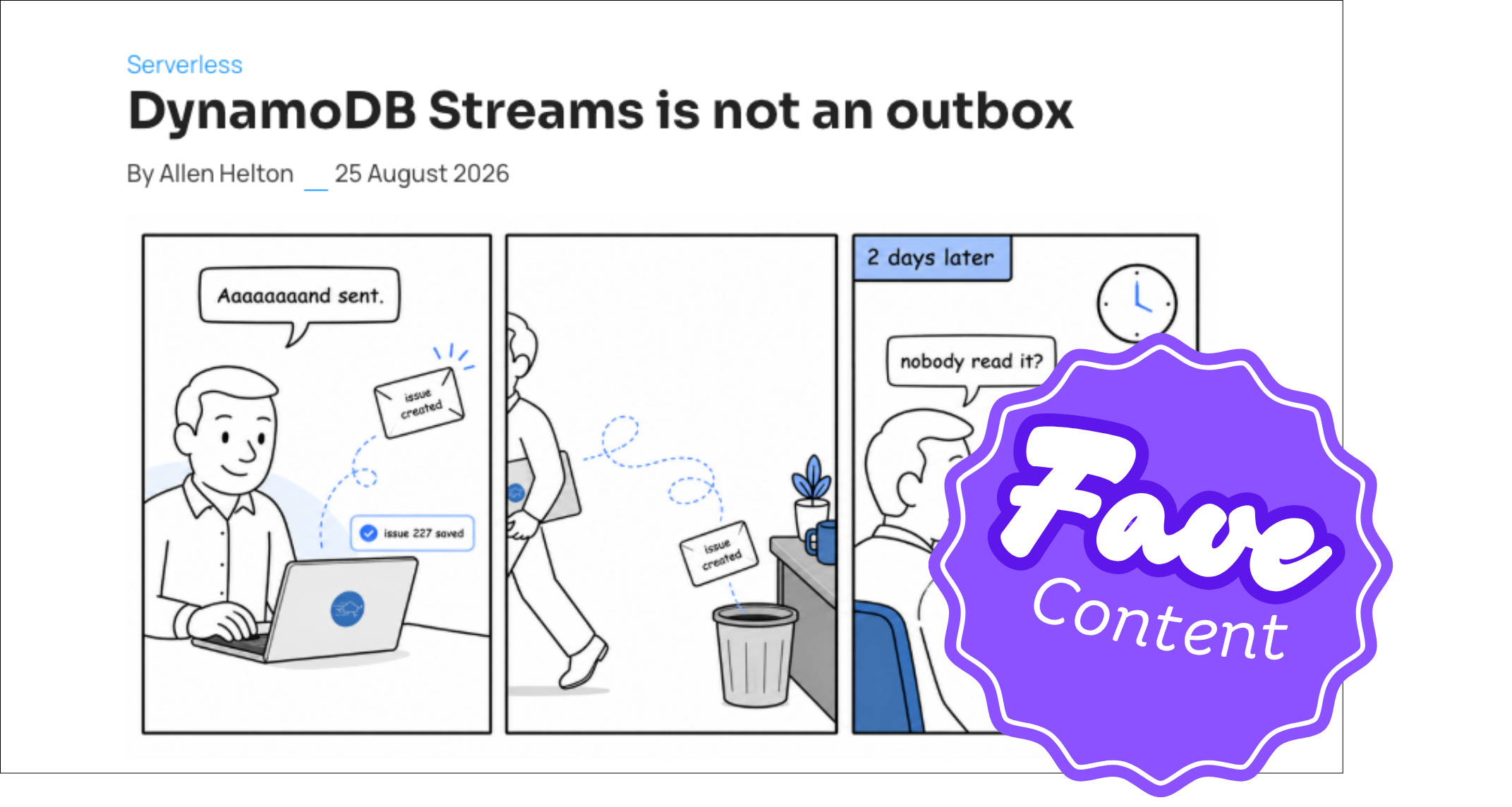
Paul Stack covers ‘The Feedback Loop Is Moving Out of CI’, a follow-up on how, once agents write the code, verification and repair move out of CI and back into the agents’ loop, revisiting what Google’s TAP, Piper and Critique built over a decade ago.
Ran Isenberg covers ‘AWS Lambda Managed Instances: My Impressions and Tradeoffs’, a hands-on look at running your Lambda functions on AWS-managed EC2 instances.
Jeremy Daly covers ‘Your AI Agent Is Only as Good as the Harness Around It’, on why the model is just one component and the harness (tool contracts, permissions, traces and tests) is what makes an agent survive contact with production.
Vadym Kazulkin continues his series with ‘Orchestrating workflows with Amazon S3 Files and AWS Lambda durable functions using Java SDK – Part 4 Wait for condition’, building a durable wait-for-condition polling step with the Lambda Durable Execution SDK for Java.
Jeremy Ron King covers ‘The Catalogue Tax: Why I Still Hand My Agents a CLI’, on a controlled study showing most agent harnesses re-send the entire MCP tool catalogue on every single turn, and why a good CLI is often the cheaper, faster bet.
Pramod Sadalage and Prem Chandrasekaran cover ‘Making Your Data Ready for Agentic AI’, on the five attributes your data needs (trusted, contextual, traceable, governed and operational) before an agent will act on it safely rather than confidently wrong.
Alberto Brandolini covers ‘Code Is Still a Side Effect’, revisiting his well-known line that software development is a learning process and working code is a side effect, and what that means now that agents do the typing.
Simon Martinelli covers ‘Code Is No Longer the Bottleneck. Requirements Are.’, a thoughtful response to Anthropic’s playbook arguing that when code becomes cheap, the quality of your requirements is the only lever left.
And finally, Matthew Skelton covers ‘Reframing the AI-Native SDLC in Terms of Stewardship Boundaries’, on treating teams as stewards of semi-automated systems, with bounded agency and clear ownership rather than yet more layers of oversight.
🎓 Ask the Expert
Each issue, I ask a different AWS expert the same three questions to get their personal insights. This issue, we have AWS Community Builder Lee Harding.

Opinions are the authors’ and do not express the views of their employer.
1. What is one common mistake you see teams making when building their solutions, and how can they avoid it?
Not trying. I see teams actively avoid innovation and bear the burden of legacy approaches and technologies for far too long - not because better options don't exist, but because of fear. Fear that nobody will care. Fear of drawing negative attention. Fear of stepping outside what's considered "normal."
This matters more now than ever. LLMs are rapidly narrowing the solution space – we're getting diverse applications built on increasingly homogeneous underpinnings.
Systems are converging on the same patterns, the same architectures, the same answers. That makes experimentation more valuable, more relevant.
My advice: if you have an idea, build it. Build outside the application layer. Build outside your area of expertise. You'll end up with a great system or learn something – either way, and the serverless ecosystem makes the cost of trying remarkably low.
2. Which tool, package, or AWS service are you most excited about right now, and why?
DynamoDB vector indexes.
Most people hear "vector" and immediately think of word embeddings and semantic search. But vector indexes are a general-purpose tool for any domain where you need to find "nearest neighbours" in some n-dimensional space – and that opens up far more than AI use cases.
Think about geometry: finding the closest shapes in a design system. Or, topology: matching network graphs by structural similarity. Or, geography: spatial queries over coordinates without a dedicated GIS stack. Or, sensor fusion: comparing multi-dimensional readings across IoT fleets.
What excites me is the breadth of the foundation. DynamoDB gives you single-digit millisecond performance, scales to zero cost at rest, and now natively supports a data structure that is useful well beyond the hype cycle it rode in on. That combination is rare, and I think we're only scratching the surface of what people will build with it.
3. What is your favourite trick or tip that the readers may find interesting?
Avoid TCP if you can. Avoid ACKs if you can. Question your transport layer.
TCP (the Transmission Control Protocol) underlies HTTP and gRPC and defines "reliability" as "every byte arrives, in order, or we stall until it does" which sounds sensible until you look closely and see how many systems are spending enormous effort fighting that at the infrastructure and application layers.
By contrast, CoAP (the Constrained Application Protocol) is based on UDP and has optional reliability. Developers using it get the familiar HTTP concepts like URIs, headers and content type. But they also get native async, binary (no text encoding), and optional reliability.
As a developer, you get to decide if a message is important enough to wait (block) for a reply, or not.
The tip: Own your own definition of reliability at the application layer - it’s simpler, cheaper, and gives you the control you actually wanted all along.
Also check out: “Serverless Integration Patterns“ by James Eastham on Study From Experts:
Overview:
Learn practical knowledge for implementing integration patterns with AWS serverless services. Who is this for? This course is for senior engineers who already use Lambda, SQS, and SNS and want to go deeper into production integration patterns. Not for beginners.
🧠 Tips & Tricks
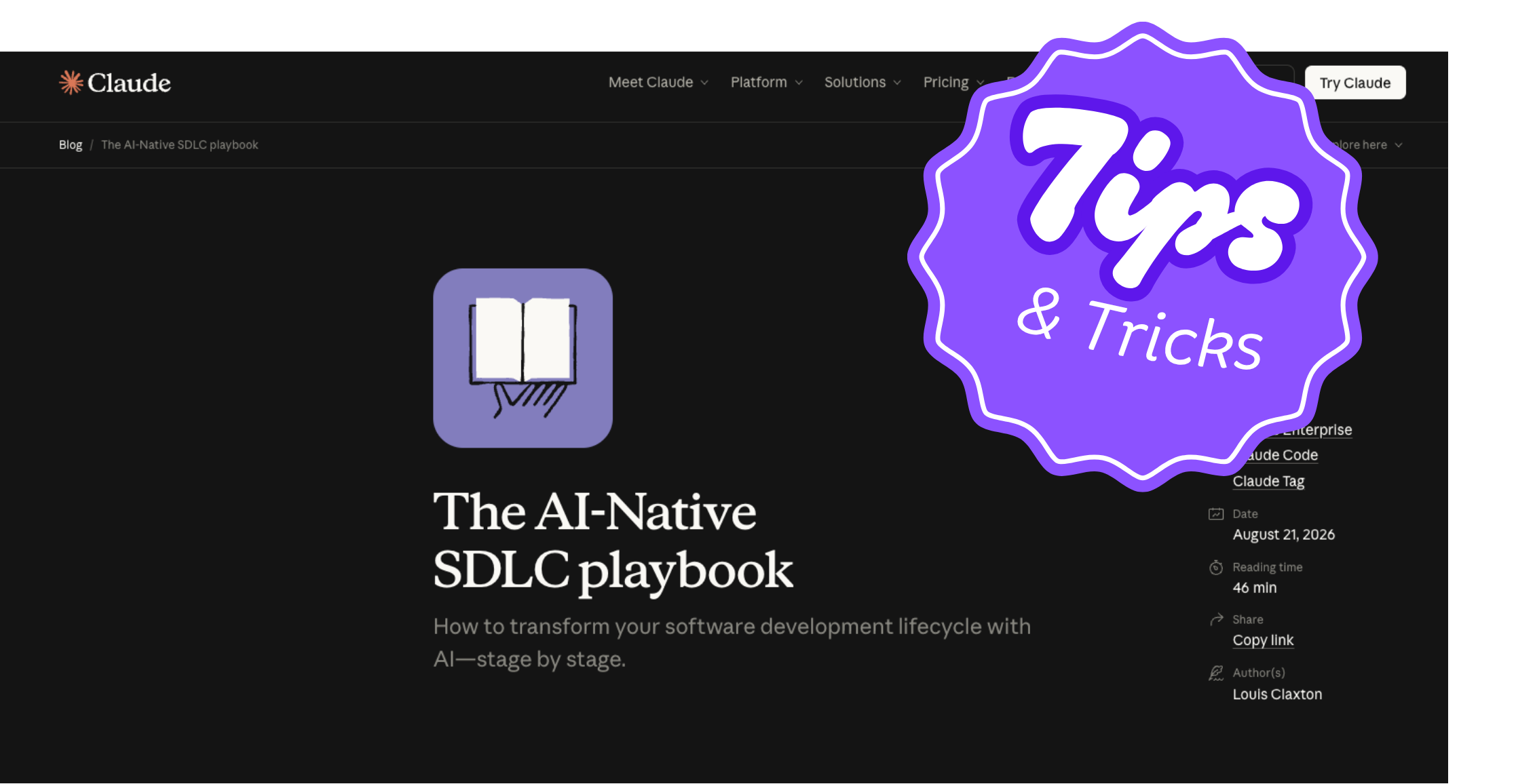
⭐ This week's tip and trick comes from Anthropic, who released their own guidance on the AI-Native SDLC (their take on the AI-DLC): 'The AI-Native SDLC playbook' — how to transform your software development lifecycle with AI, stage by stage.
The core message is that code is no longer the bottleneck. Once agents can write the diff in hours, the constraint moves to the human-speed steps either side of the build.
The playbook walks through six stages (Plan, Design, Build, Test, Deploy and Maintain), each committing a versioned artefact the next stage reads (intent.md, spec.md, plan.md, the diff, the PR, the incident record), turning the linear SDLC into a loop with AI embedded at every point and humans staying in control.
My Take: I love that this puts the artefacts in the repository as first-class citizens.
It lines up almost exactly with how I run my own AI-DLC. For me personally, it is a graph rather than a loop, and has distinct optional sub-flows for the agents (not so linear), with distinct outputs feeding into stages in the graph as inputs.
What tips and tricks do you have?
🚀 New Releases
Here are the latest and most interesting releases over the past two weeks in the AWS World.
⭐ My fave release over the past couple of weeks was Amazon Cognito supporting M2M flows with a user pool domain - so I can’t wait to try this out in practice.
Amazon API Gateway now supports mutual TLS for backend integrations.
OpenAI GPT-6 Astra is now generally available on Amazon Bedrock.
Amazon S3 Object Lock now supports variable retention with event holds.
AWS announces Nx Plugin for AWS for scaffolding full-stack applications.
Amazon Bedrock AgentCore Memory now supports direct ingestion to long-term memory.
AWS CloudFormation now supports contract tests v2 for resource types.
Dynamic Image Transformation for Amazon CloudFront adds four new features.
Amazon ECS introduces Early Success Criteria for service deployments.
AWS MCP Server adds a serverless capability for AWS Lambda functions.
Amazon Bedrock AgentCore Identity now offers a managed consent portal.
AWS Lambda now supports SnapStart for container image functions.
Claude Fable 5.1, Anthropic’s new frontier model is now available on AWS.
Amazon DocumentDB now supports direct major version upgrades to version 8.0.
Amazon Cognito now supports machine-to-machine authorization without a user pool domain.
✖️ Social of the Week
This week's social is this post on LinkedIn by Eduardo Ordax, which opens with "Software engineers have never had more power to build beyond their imagination…".
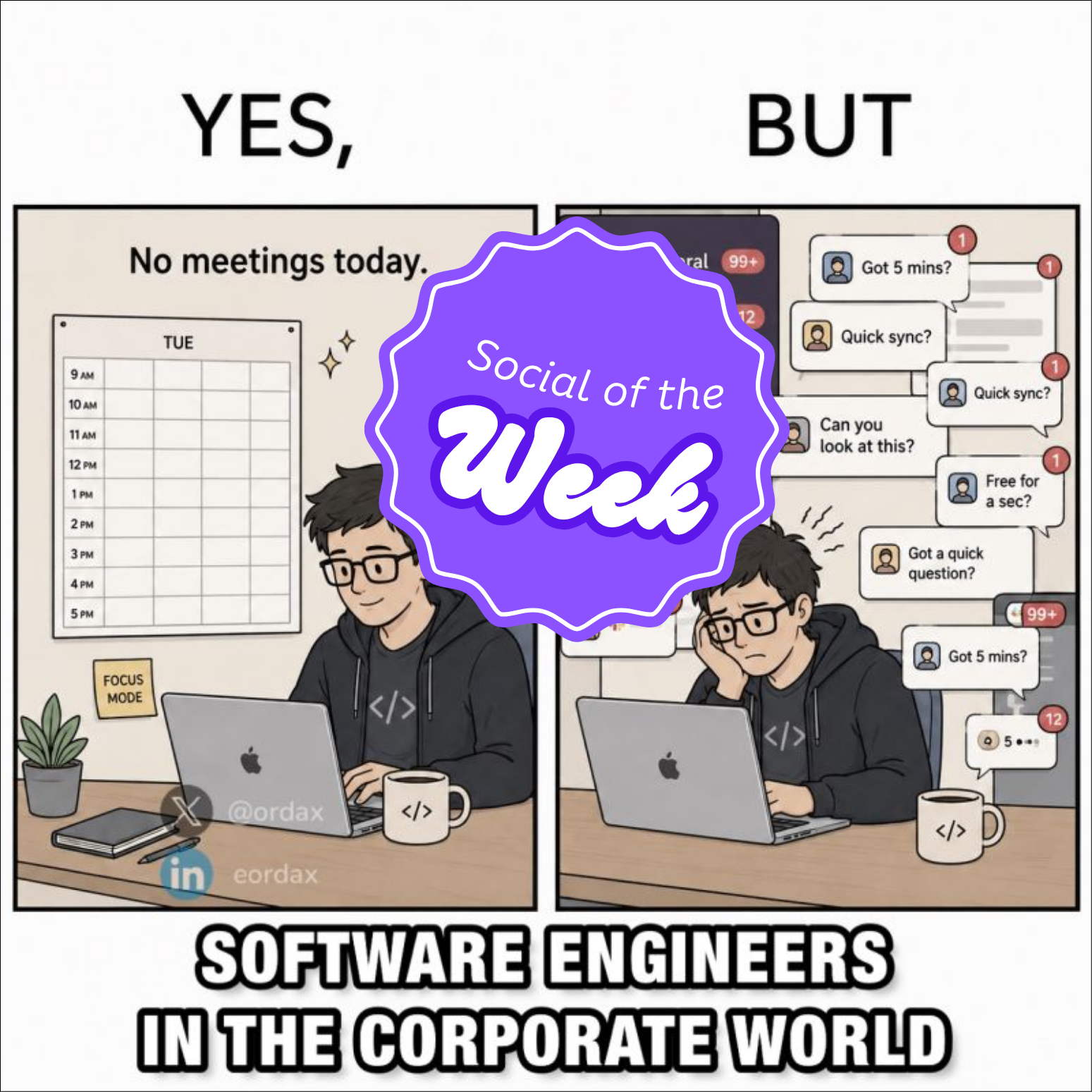
Software engineers have never had more power to build beyond their imagination.
Yet big corporations are struggling to deliver at the speed AI is evolving.
The problem isn't the developers. It isn't the quality of the AI tools either.
It's the corporate operating system.Last week, a principal software engineer at one of Europe's largest banks told me he spends more than 50% of his time in meetings, repeating the same story to different stakeholders, often with zero outcomes.
And when he finally clears his calendar, Slack is already burning with dozens of "quick questions." This isn't an isolated case.
It's the daily reality of many builders inside large organizations.
AI has accelerated coding. But it hasn't accelerated approvals, politics, alignment, or decision-making.That's why many talented engineers eventually leave to build their own products. They want to build, not spend 90% of their time discussing what they might build.
My take: This one really resonates. AI has made the coding part faster, but it has done nothing for the approvals, alignment and politics that surround it, and in a lot of large organisations, that is exactly where the time goes.
This is where we work now in dedicated small pods with dedicated boundaries of full-stack engineers, with a mixture of pairing and mobbing, with limited meetings, and constant delivery of value to the customer. That boundary means we reduce the outside noise and keep everything internal to the team and any stakeholders.
What are your own thoughts on this? How are you working?
🗞️ AI & Technology News
Here is some of the latest news you may have missed over the past week:
Fermat’s last theorem formalised by AI agents in just 11 days
OpenAI agents hijacked German website before Hugging Face hack, report claims
How AI plotted an interstellar journey to Alpha Centauri
👷🏻 Tools & Frameworks
Check out the latest open-source frameworks, news, and tool updates from the past two weeks.
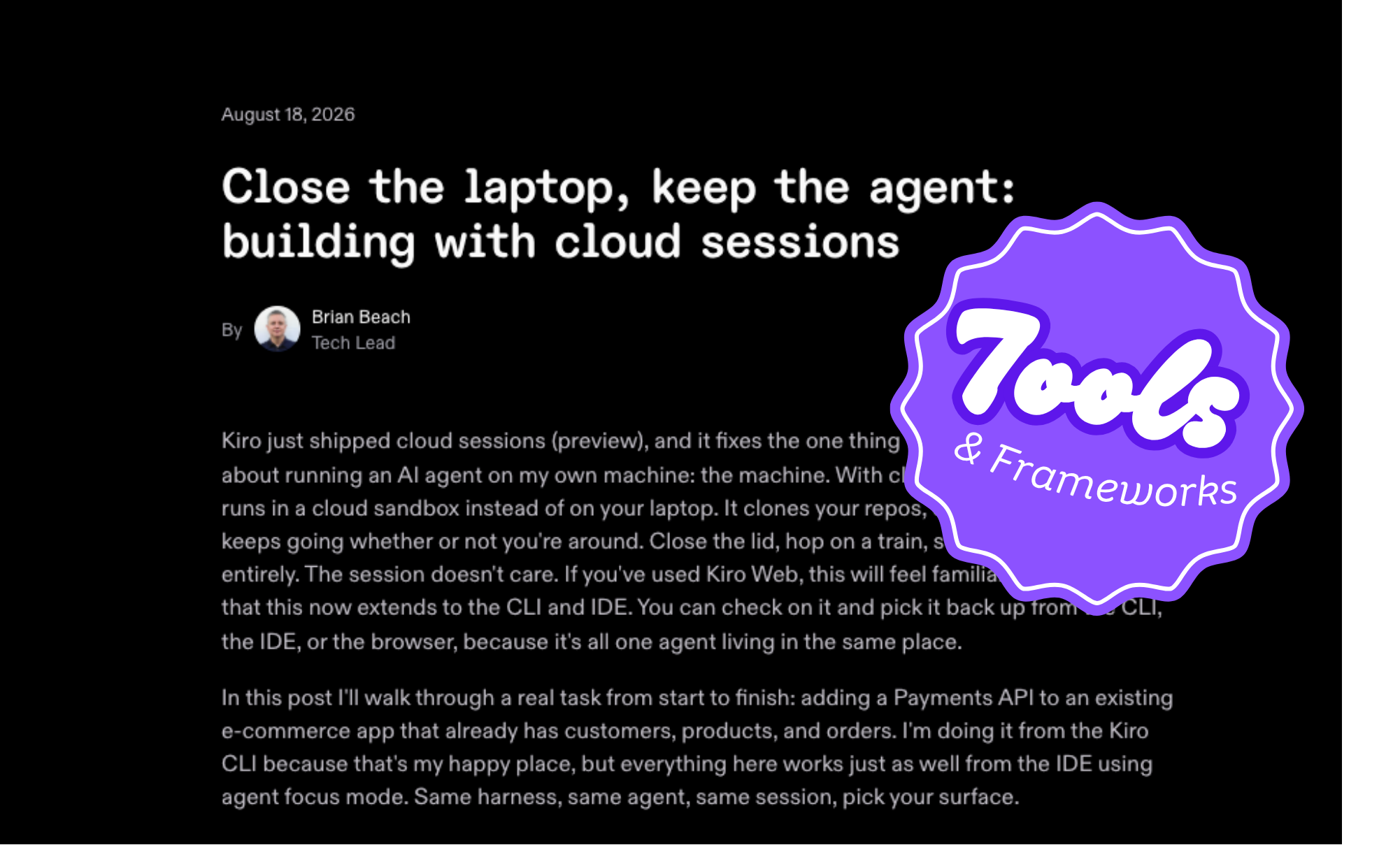
⭐ My highlight this issue is Kiro cloud sessions ('Close the laptop, keep the agent'), which move your agents off your laptop and into a cloud sandbox. It clones your repos, does the work, and keeps going whether or not you are around, and you can pick the same session back up from the CLI, the IDE, the web or mobile. No more babysitting a process with the lid cracked open (I do this a lot when walking around airports!).
utopia by DeepLethe bills itself as the world’s first open-source enterprise world model: a bitemporal knowledge graph that puts time-awareness and ontology in the base layer, runs from one Rust binary and one Postgres, and deploys offline so a company can stand up a trustworthy decision core and audit trail on hardware it controls.
ecs-truly-auto-mode by Matthew Bonig is a Claude Code skill that takes a repository with a Dockerfile and gets it running on ECS by reading the code first, showing you every inference with the file and line that supports it, and handing you CDK you own rather than hidden resources.
knowledge_graph by Rahul (rahulnyk) converts any body of text into a graph of knowledge for Graph-augmented generation and knowledge-graph based QnA, running entirely locally with Mistral 7B and Ollama so generation is essentially free.
acp-inspector by Ryan Cormack is a browser-based client and debugger for the Agent Client Protocol (ACP), giving you a live view of JSON-RPC traffic, streamed messages, tool calls, permission requests, stderr and protocol errors.
agent-orchestrator by Untrivial AI is a local agent IDE for managing fleets of coding agents, with an orchestrator that plans tasks, spawns agents in isolated worktrees, and autonomously handles CI fixes, merge conflicts and code reviews across a live Kanban view.
EventCatalog Federation by David Boyne lets every team own their documentation in their own repository, close to their code, while your organisation catalogue pulls, syncs and verifies them into one connected, validated view of your architecture, with one owner per resource and no copy-paste drift.
sample-bedrock-image-preprocessor from AWS is client-side image preprocessing for Amazon Bedrock inference requests, replicating the optimisation OpenAI and Anthropic do server-side and cutting image token consumption by 10-20x (a 4000x3000 photo drops from ~30,000 tokens to ~1,600).
And finally, openworker by Andrew Ng is an open-source AI coworker that lives on your desktop and delivers finished work rather than chat, shipping specialist Security coworkers first, running on your own keys or local models, with governance built into the architecture.
😂 Just for Fun
This issue’s just-for-fun posts are these two below on LinkedIn.
The first pokes fun at how the Egyptians ever managed to build the pyramids without daily standups. Sarcastic, but totally true!

In my AWS practice, we limit all of the unnecessary meetings that we used to have in the older SDLC and focus on delivering value quicker. A catch-up in the morning is totally optional!
The second reckons the Oxford Dictionary's 2026 word of the year has been found: "Meat Proxy" — someone who pipes AI output straight to colleagues without ever reading it themselves.
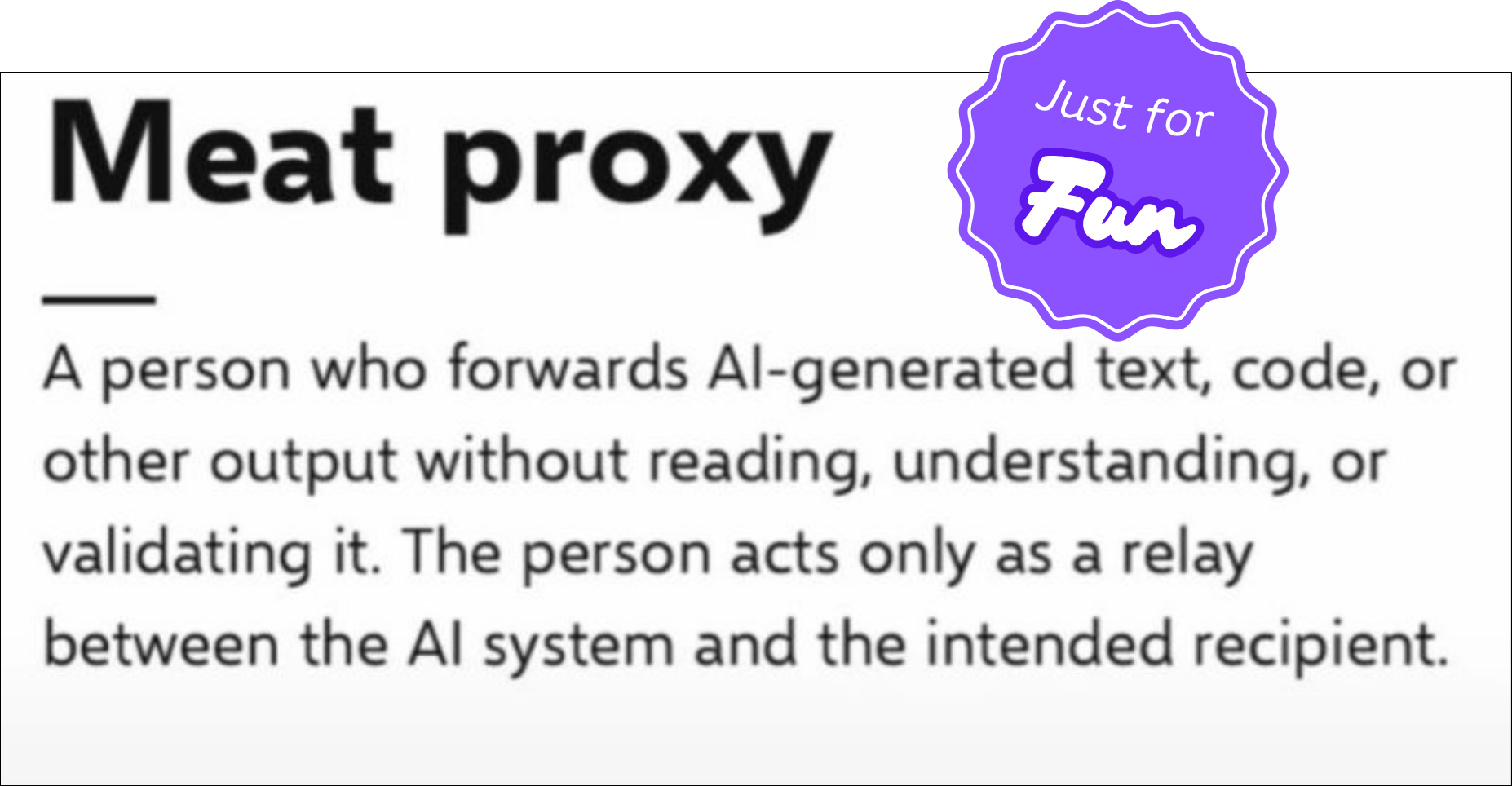
My take: I honestly push back instantly when I see AI-generated responses when I have asked team members a question. I want their raw thoughts, not the mumblings of an AI agent. Or, I go back and ask more deeper questions quickly, which usually results in them not having the answers. AI is a tool, not a replacement for critical thinking!
🎙️ YouTube & Podcasts
Here are some of my favourite videos and podcasts over the past two weeks covering serverless, AI, architecture, and software engineering.
⭐ My highlight this week is the AI Engineer channel with 'Agentic SDLC at Uber — Uday Kiran Medisetty & Adam Huda, Uber', on how Uber runs an agentic software development lifecycle at real scale.
Yells at Cloud (Gunnar Grosch, Danielle Heberling, Matthew Bonig and Chris Farris) published ‘The Slow Collapse of Civilization’, on AI agents escaping their sandboxes, Grok Bot’s autonomous virtual coworkers, AWS’s Project Region Flex, and a gas-powered AI data centre in Texas.
Johannes Koch on the Build. Automate. Ship Smarter in the Cloud. channel shares ‘How to start your Build In Public journey’, a short on getting going with building in public.
Lenny’s Podcast features Tara Seshan, OpenAI’s product lead, in ‘AI’s third era: the rise of persistent AI coworkers’, on where AI moves once agents stop being one-shot tools and start persisting as coworkers.
Dave Farley on the Modern Software Engineering channel covers ‘The Crucial AI Shift You Need to Master Right Now’, on the shift in discipline he thinks matters most as AI reshapes how we build.
ThePrimeagen on The PrimeTime channel covers ‘Protecting Your Energy’.
Derek Comartin on the CodeOpinion channel covers ‘Domain Events Are NOT Your Public API’, on why leaking your internal domain events as an integration contract will come back to bite you.
And finally, Lex Clips published ‘Programmers vs non-programmers in agentic AI era | DHH and Lex Fridman’, a clip on where DHH lands on who thrives in the agentic era.
Weekly Case Study 🔍
This week’s case study is Ryanair’s agentic AI on AWS: ‘Agentic AI Handles 120,000 Daily Chats Using Amazon Nova at Ryanair’.
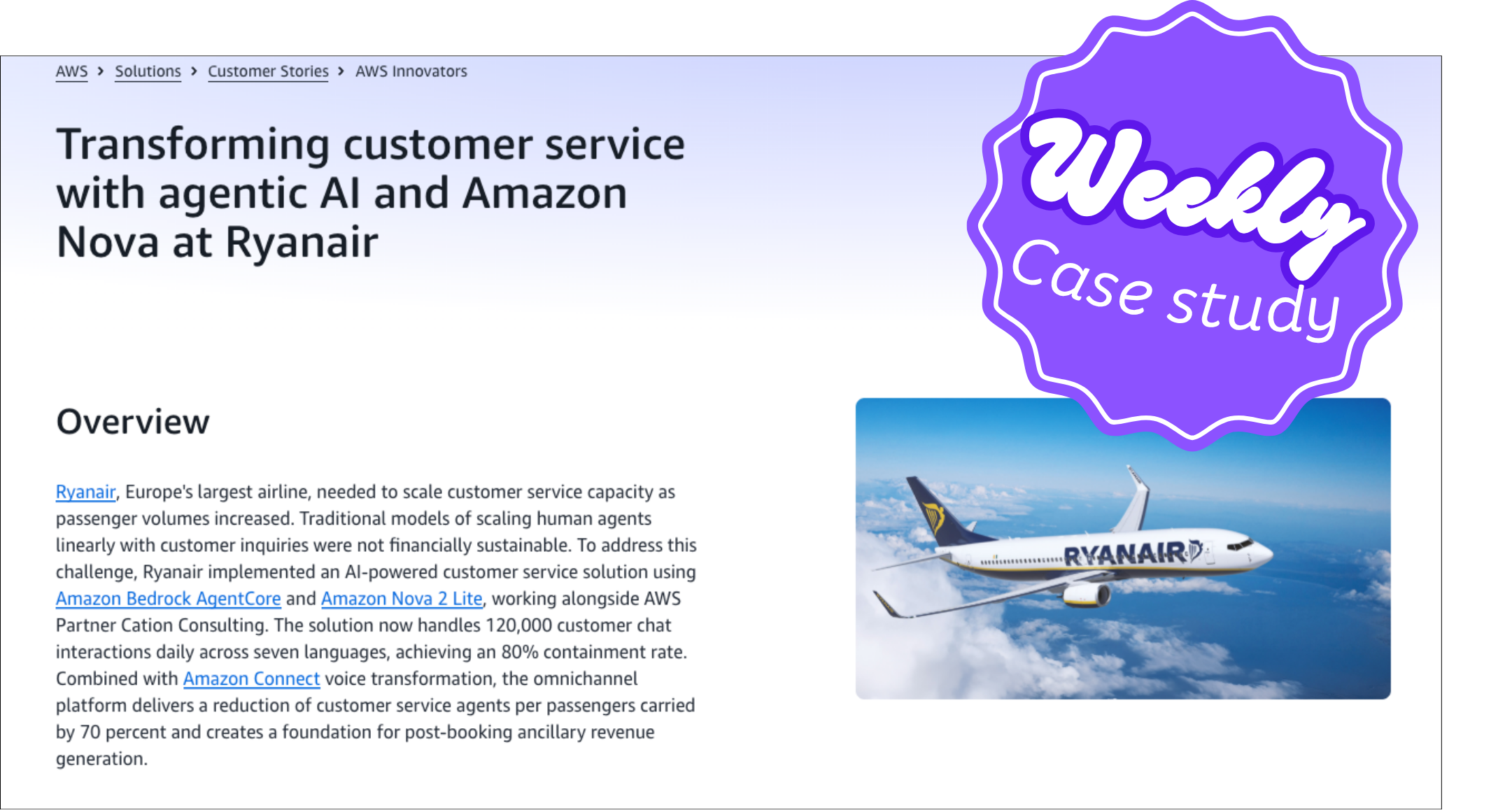
Ryanair built a customer-service AI assistant on Amazon Bedrock AgentCore, powered by Amazon Nova 2 Lite, handling everything from baggage and refunds to bookings and flight disruptions in one unified architecture.
In February 2026, they replaced an earlier design of 12 domain-specific agents with a single consolidated agent, reducing latency and simplifying orchestration.
The numbers are the interesting part. Testing five foundation models against 12,000 real production questions, Amazon Nova 2 Lite delivered an 84% latency improvement (response time dropped from 18 seconds to 2.9 seconds) alongside a 25% accuracy uplift, validated in production within weeks.
Every answer is scored by a multi-model guardrail system before it reaches a customer, and Amazon Translate handles six non-English languages across European markets, with Amazon Connect tying voice and chat into one omnichannel platform.
🗣️ Inspirational Quotes and Thoughts
This week’s inspirational thought was by Andrej Karpathy (former Director of AI at Tesla and OpenAI co-founder), on how natural language prompts have become the primary interface for software creation (this quote is from a year or two back).

“The most popular new programming language is English.”
My take: It's so funny to think we are living in a world now of using natural language for our input into coding tasks, and some of the main outputs are now stored in markdown!
I never envisaged this World 5-10 years ago! What do you think is the next evolution after natural language prompts and voice? Is it dedicated persistent agentic co-workers in your team, communicating through Slack?
What are your thoughts?
🗳️ Poll of the Week
In the previous issue, we asked the question “How is your mental health and cognitive load with the new World of AI-assisted coding?” The results were 40% super productive and happy, 40% it’s not different, and 20% my brain is melting, and it is stressful.
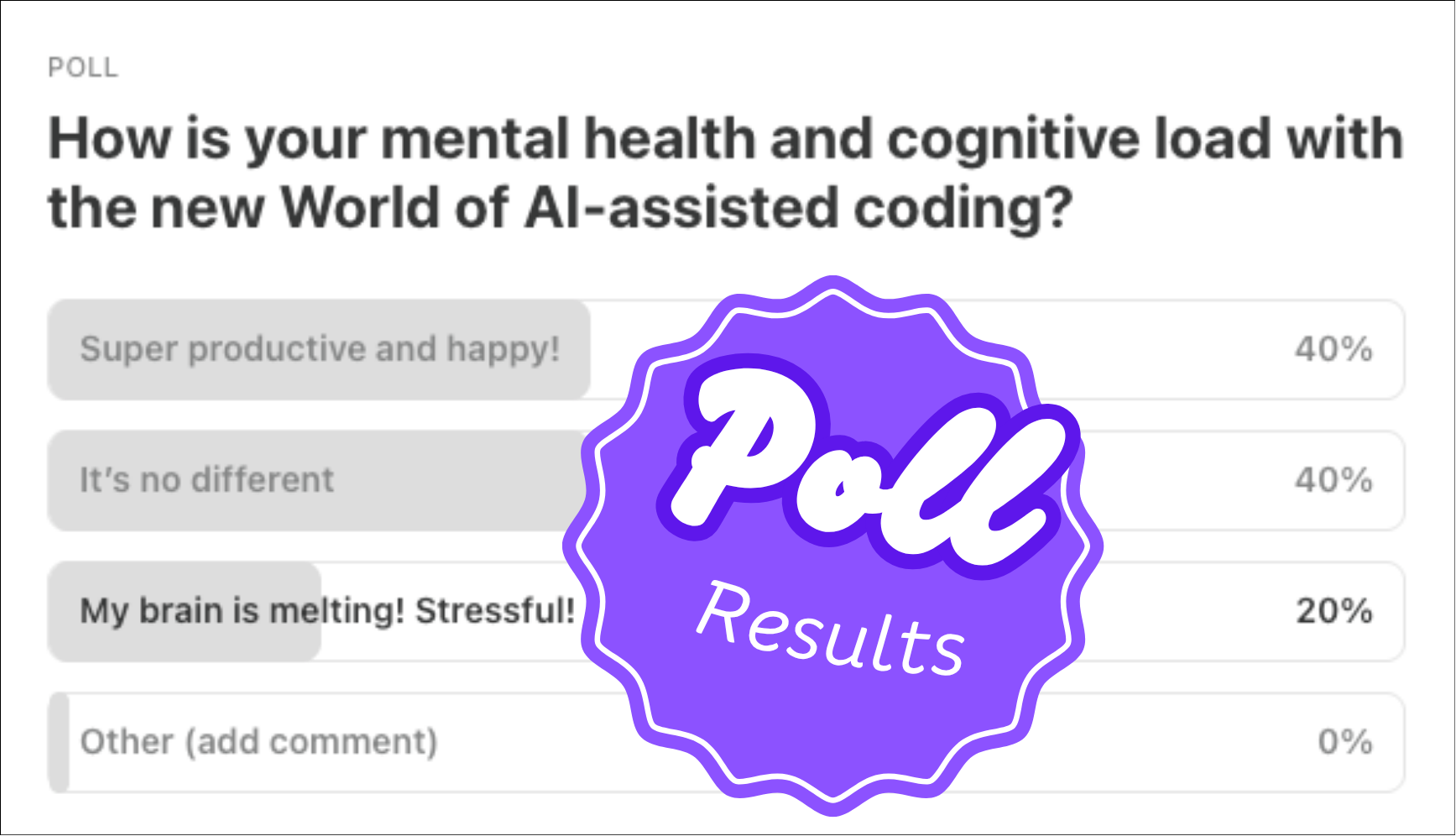
My thinking is that, from working in multiple teams and companies as both a consultant and part of internal teams, I see cognitive load being a real issue for some team members.
It is not so much the context switching, but the constant learning: new AI approaches, new frameworks, and the endless changes and releases in their IDEs and tooling. It’s a lot! Nothing has felt stable for the last year, and I don’t think it will be for another year or two yet.
This issue we ask the question: "What is your go-to serverless database of choice these days?"
Yes, this totally depends on the use case of the system, sure, but what is your go-to for most greenfield systems?
Please feel free to leave a comment below with your answer.
📅 Serverless Events
The following serverless events are upcoming, so mark your calendars.

AWS Community Summit Manchester - 1st Oct 2026.
AWS North Community Conference - 15th Oct 2026.
ACD Adria - 22nd Oct 2026.
Would you happen to have any upcoming events that you would like to highlight?
Message me below!
⭐ Spotlight
This issue's spotlight falls on AWS Senior Solutions Architect, AWS Certifications, Julie Elkins!

Julie is deeply committed to fundamentals, certifications, and helping others across our community learn and build a solid foundation in AWS. With a background in teaching, spanning A Cloud Guru, AWS and the Linux Academy, she holds a long list of AWS certifications and shares her knowledge widely across our community.
She also recently published northwind-connect-ai, an excellent reference implementation of a customer-service AI agent on Amazon Connect and Bedrock!

You can follow Julie on LinkedIn, on YouTube, and on GitHub.
Thank you for everything you do for the community, Julie!
Thank you for reading the latest Serverless Advocate Newsletter!
If you want to find out a little more about me, please have a look at
https://www.serverlessadvocate.com/
See you next time,
Lee

Code is no longer the bottleneck lands because each of the six stages commits a versioned artefact — intent.md, spec.md, plan.md, the diff, the incident record are a compile pipeline, with natural language as the source language and the artefacts as intermediate representations. Versioning those intermediates is the whole ballgame: it makes intent diffable and revertible, which is what turns AI wrote it into a system you can govern. It also explains why the constraint moved to the human-speed steps either side: humans now own the compiler front end, writing the source, and the back end, reconciling the incident record into the next intent. That artefact chain is the through-line of our Agents Don't Equate to Agency series — the model is rented; the harness, the contracts, the exits are what you own: https://seldondance.substack.com/p/agents-dont-equate-to-agency
#AIAgents #AIQuality